
1. The Midnight Prototype: A New Way to Build
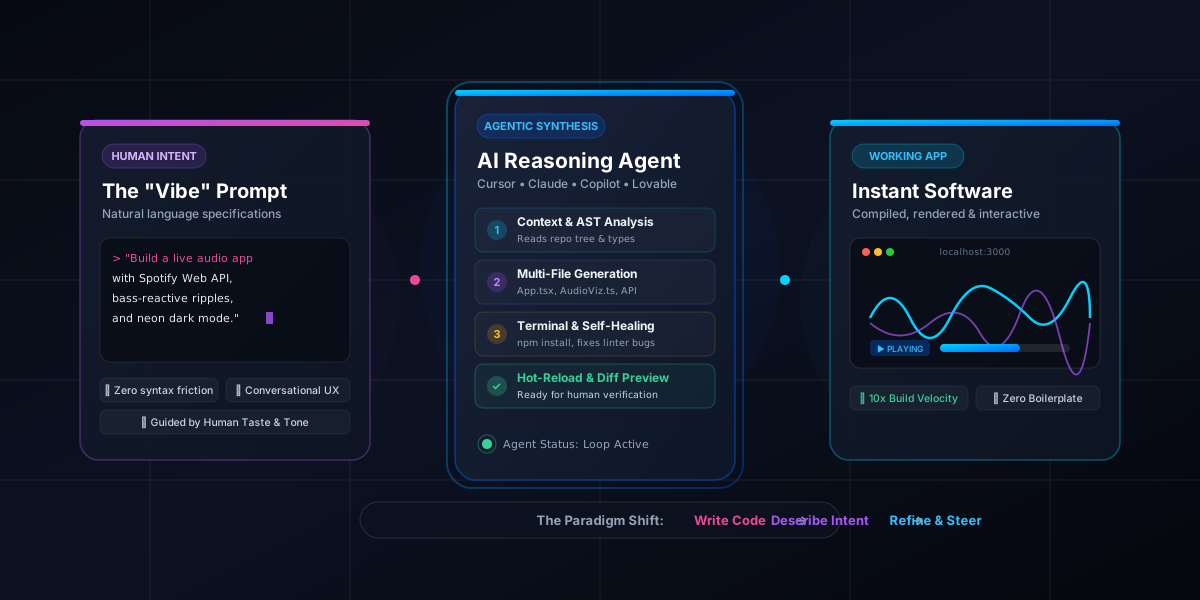
It is 11:42 PM on a Tuesday. A software developer sits in front of a dual-monitor setup with a warm mug of tea. But their screen does not show a blank App.tsx file, an empty directory structure, or a terminal stalled on a cryptic Webpack configuration error.
Instead, their cursor blinks inside a single conversational prompt box. They lean into their microphone and speak plainly:
"Build me a real-time audio visualizer dashboard that connects to the Spotify Web API. I want retro-neon glassmorphic cards, keyboard shortcuts for playback controls, a bass-reactive particle canvas, and a drawer that displays live lyrics synchronized with timestamps."
They press Enter. They don't write a single line of TypeScript. They don't scaffold Redux slices, configure Tailwind color palettes, or spend forty minutes wrestling with CSS Flexbox centering quirks.
Over the next ninety seconds, an autonomous AI coding agent springs into motion. It analyzes the project's dependency tree, scaffolds twelve modular components, installs necessary audio-processing libraries, writes custom Canvas rendering shaders, generates REST API wrappers, and executes a local development server.
A window pops up on the right monitor: localhost:3000 is live. The developer clicks play, watches glowing magenta ripples pulse across the screen in sync with the beat, taps the spacebar to pause, and smiles. They notice the waveform transitions feel slightly sluggish. Instead of inspecting 800 lines of canvas trigonometry, they type three words:
"Make the ripple damping 30% faster and add a subtle chromatic aberration shader on bass drops."
Twenty seconds later, the hot reload triggers. The animation is silky smooth. The entire application was conceived, architected, implemented, and refined in under eight minutes—without the developer manually typing a single semicolon.
This is vibe coding. It feels less like laboriously translating human cognition into arcane machine syntax, and more like conducting a hyper-competent orchestra of autonomous software agents at the speed of thought.
2. What Is Vibe Coding? Origins and the Karpathy Spark
At its core, vibe coding is a software creation methodology where the human developer operates primarily as an architect, creative director, and evaluator—communicating software specifications, aesthetic desires, and functional behavior in natural human language—while an autonomous AI agent writes, edits, tests, and compiles the underlying code.
The term was officially introduced to the world in early February 2025 by Andrej Karpathy—renowned AI researcher, founding member of OpenAI, and former Director of AI at Tesla. In a widely shared post that captured the industry's imagination, Karpathy wrote:
"There is a new kind of coding I call 'vibe coding', where you entirely give in to the vibes, embrace every whim, talk to the AI, and never touch the code yourself... I just see stuff, say stuff, run it, copy-paste error messages back to the AI, and it works. I barely even look at the code anymore."
Karpathy described building small tools, web experiments, and utility scripts entirely through voice dictation and agentic IDEs like Cursor Composer and Claude. When an error surfaced in the terminal, he didn't set breakpoints or open debugger panes—he simply pasted the stack trace back to the model and said "fix this."
What started as a playful phrase quickly ignited a global discourse across Silicon Valley, engineering teams, tech Twitter/X, Reddit, and enterprise boardrooms. In the months following Karpathy's post, "vibe coding" matured from an eccentric developer hobby into a recognized category of software engineering practice.
Why Did Vibe Coding Explode in Popularity?
Vibe coding didn't emerge in a vacuum. It was propelled by the confluence of three massive technological breakthroughs between 2024 and 2026:
- Frontier Reasoning Models: The release of advanced reasoning LLMs (such as Claude 3.7 Sonnet with hybrid extended thinking, OpenAI's o-series and GPT-4.5, and Gemini 2.5/3.0 Pro) gave models the ability to plan complex multi-step refactors, reason through abstract system invariants, and self-correct logic errors before rendering output.
- Agentic Tool-Calling & File Manipulation: AI assistants evolved from passive text predictors into autonomous agents capable of reading entire file trees, running bash commands, invoking linters, handling Git operations, and resolving compilation errors.
- Next-Generation AI IDEs: Platforms like Cursor, Windsurf, Claude Code, and Lovable eliminated the friction of copying and pasting code between a chat window and an editor. The AI lives directly inside the runtime environment.
3. The 70-Year Paradigm Shift: Writing Code vs. Describing Intent
To understand why vibe coding is so transformative, we must look at the history of software engineering as a continuous march toward higher levels of abstraction:
Machine & Assembly
Engineers manually managed registers, memory addresses, and CPU opcodes. Hardware-centric, painfully slow, zero tolerance for error.
High-Level Languages
C, Fortran, and Pascal abstracted hardware registers into variables, loops, and functions. Compilers translated human logic into machine code.
Frameworks & Web
Python, Ruby on Rails, React, and npm package ecosystems abstracted boilerplate plumbing into reusable open-source modules.
Vibe & Intent Coding
Natural language becomes the supreme programming syntax. The developer directs architecture; autonomous AI agents synthesize implementation.
For decades, the central bottleneck of software development was syntax translation: taking a human thought ("I want a button that charges the customer's card and sends a receipt email") and spending three days writing HTTP endpoints, Stripe webhook handlers, database migrations, error boundaries, and email templates.
Vibe coding collapses that translation layer. The developer's primary cognitive effort shifts from writing syntax to articulating intent and evaluating system behavior.
4. How Vibe Coding Works: The 3-Stage Feedback Loop
Behind the effortless feeling of vibe coding lies a rigorous, cyclical feedback loop between human intent and autonomous machine execution:
Intent Expression
The human defines requirements, constraints, visual tone, and domain logic using natural language prompts, mockups, or project rule files (.cursorrules, CLAUDE.md).
Agentic Synthesis
The AI agent inspects repository context, constructs an execution plan, generates multi-file diffs, runs terminal commands (build, lint, test), and self-repairs runtime failures.
Sensory Evaluation
The human tests the live application, verifies edge cases, reviews Git diffs, and feeds sensory or behavioral feedback back into the prompt loop for iterative refinement.
A Concrete Example: Building a Full-Stack Feature in 4 Minutes
Consider a developer adding an automated CSV export and analytics chart feature to an existing SaaS application. Here is what the vibe coding exchange looks like in practice:
> "Add an Export to CSV button on the User Analytics table. When clicked, generate a formatted CSV with columns (User ID, Signup Date, Monthly Spend, Plan Tier, Status), trigger a browser download, and show a subtle toast notification with a confetti burst. Ensure it works smoothly with datasets up to 50,000 rows without freezing the UI thread."
The AI agent immediately executes the following multi-file orchestration:
- Spawns a background Web Worker (
exportWorker.ts) to process CSV chunking without blocking UI rendering. - Creates a customized hook
useCsvExport.tsthat manages loading states, download streams, and memory garbage collection. - Updates the UI component
AnalyticsTable.tsxwith the new export button, tooltips, and toast triggers. - Installs lightweight dependencies (
canvas-confettiand types) via the integrated terminal. - Runs the test suite
npm test -- --grep "useCsvExport"and verifies zero regressions.
The developer never touched the Web Worker message passing syntax or Blob URL creation logic. They simply tested the download on a staging dataset, verified the performance, and committed the changes.
5. The Modern Vibe Coding Tool Stack
The vibe coding landscape has evolved into several specialized categories, ranging from deeply integrated desktop IDEs to canvas-based visual full-stack builders and autonomous CLI agents.
| Category | Leading Tools | How It Operates | Best Suited For |
|---|---|---|---|
| Agentic IDEs | Cursor Windsurf Copilot Agent | Full IDE forks with native multi-file composer engines, terminal access, indexing, and background code validation. | Full-stack developers, complex existing codebases, large commercial repositories. |
| Autonomous CLI Agents | Claude Code Aider OpenHands | Terminal-native agents that read git trees, execute shell commands, edit files across directories, and manage PRs. | Terminal power users, DevOps workflows, backend refactoring, automated bug fixes. |
| Prompt-to-App Platforms | Lovable v0 (Vercel) Bolt.new | Browser-based sandboxes that build complete React/Next.js/Supabase apps directly in the browser with one prompt. | Founders, product designers, marketers building MVPs, landing pages, and interactive prototypes. |
| Autonomous SWE Bots | Devin SWE-Agent Cosine Genie | Asynchronous virtual software engineers assigned full GitHub issues to clone, reproduce, solve, test, and submit as PRs. | Enterprise backlogs, dependency upgrades, migrating legacy code, long-running bug hunts. |
The Engine Powering the Vibes: Frontier Reasoning Models
The software tools above are execution shells; the true intelligence comes from the foundation models powering them:
- Claude 3.7 Sonnet (Anthropic): The first hybrid reasoning model capable of switching dynamically between instantaneous response generation and deep, extended step-by-step thinking for complex multi-file architectural planning.
- OpenAI GPT-4.5 / o3-mini: Exceptional performance across deep logical verification, mathematical accuracy, and zero-shot code generation.
- Gemini 2.5 / 3.0 Pro (Google): Industry-leading million-token context windows capable of ingesting an entire corporate code repository and documentation library in a single prompt.
6. Real-World Use Cases: Where Vibe Coding Thrives
Vibe coding is not just a party trick for building To-Do lists. Teams and creators around the globe are deploying it across high-value real-world environments:
1. 0-to-1 MVP Creation & Startup Speedruns
Solo founders and lean teams are building production-ready SaaS applications in single weekends. Tasks that historically required a team of three—frontend engineer, backend engineer, and UI designer—can now be orchestrated by a single product-minded founder who understands user psychology and business workflows.
2. Custom Internal Tools & Operations Automations
In most companies, internal tooling requests (custom CRM dashboards, inventory reconciling scripts, marketing lead scrubbers) languish in engineering backlogs for quarters. With vibe coding, non-engineering staff or operations leads can create custom, tailored internal web tools in an afternoon using tools like Lovable, Cursor, or Retool AI.
3. Creative Explorations, Spikes & Design Prototypes
Before committing millions of dollars to a new product line, engineering leads can "vibe code" three completely different architecture prototypes or interactive user interfaces in 48 hours to test feasibility, performance, and user feedback before formal sprint planning.
4. Empowering Domain Experts (Scientists, Doctors & Analysts)
Bioinformaticians analyzing genomic datasets, financial quants testing algorithmic strategies, and researchers processing massive tabular archives can now build sophisticated data pipelines and interactive dashboards without being blocked by lack of traditional software engineering backgrounds.
7. Vibe Coding vs. Traditional AI-Assisted Development
Many people mistakenly conflate vibe coding with standard AI-assisted coding. However, they represent fundamentally different paradigms of human-computer interaction:
| Dimension | Traditional Manual Coding | AI Copilot (2021–2024) | Vibe Coding (2025–2026+) |
|---|---|---|---|
| Primary Input | Manual typing of syntax tokens | Tab-accepting inline code completions | High-level natural language intent & system specs |
| Scope of Generation | Single line / manual function | Line-by-line or single-file block | Entire multi-file architectures & connected repositories |
| Cognitive Focus | Syntax, memory, algorithms, libraries | Writing skeleton, verifying completions | User experience, product architecture, system evaluation |
| Tool Autonomy | Zero (Passive IDE) | Low (Passive autocomplete suggestions) | High (Reads files, runs terminal, executes tests, auto-fixes) |
| Barrier to Entry | High (Requires years of CS & syntax mastery) | High-to-Moderate (Must know how to write code) | Low-to-Moderate (Requires clear thinking & domain vision) |
| Debugging Method | Step-through debuggers & manual log analysis | Human inspects error and edits code | Human pastes error log or symptoms; AI agent diagnoses and patches |
8. The Hidden Traps: Security Risks, Architecture Rot & Limitations
While the speed of vibe coding is intoxicating, building software without discipline is fraught with severe technical hazards. Anyone adopting this workflow must confront its serious limitations:
Allowing an AI model to write thousands of lines of software without human comprehension introduces systemic vulnerabilities that can destroy production infrastructure if left unmonitored.
1. Dependency Hallucinations & "Slopsquatting" Attacks
AI models frequently hallucinate non-existent package names when trying to solve niche problems (e.g., npm install fast-jwt-validator-v2). Malicious actors and cybersecurity threat groups monitor common AI package hallucinations, register those package names on npm or PyPI, and inject info-stealing malware or reverse shells into the ecosystem.
2. Silent Security Blindspots
Because the developer doesn't inspect every line, common security oversights slip in unnoticed:
- Permissive CORS Policies: AI defaults to
Access-Control-Allow-Origin: *to make quick local APIs work. - Broken Object Level Authorization (BOLA): Endpoints that fetch user data by ID without verifying if the requesting user owns the record.
- Hardcoded Secrets & API Keys: AI dropping live OpenAI or Stripe keys directly into client-side JS bundles.
- Unsanitized SQL / Prompt Injection: Unescaped inputs passed straight into raw database queries or downstream LLMs.
3. "Spaghetti Code at the Speed of Light"
AI models are stateless optimizers for the immediate prompt. If you ask an AI agent to add five features in a row without strict architectural rules, it will often create three duplicate helper functions, mutate global state in unpredictable ways, and invent contradictory abstractions. You end up with 15,000 lines of brittle code that no single human understands.
4. The "90% Trap" (The Last-Mile Problem)
Vibe coding makes getting from 0% to 90% of an application feel effortlessly fast (often taking just a couple of hours). But the final 10%—handling rare race conditions, optimizing distributed database deadlocks, meeting SOC2/HIPAA compliance, and ensuring sub-50ms latency under 100,000 concurrent websocket connections—still demands elite, battle-tested software engineering expertise.
9. From Vibe Coder to Vibe Engineer: Best Practices & Disciplined Workflows
The highest-performing developers in 2026 are not refusing to vibe code, nor are they blindly trusting every AI hallucination. Instead, they practice "Vibe Engineering"—combining the raw velocity of natural language coding with the ironclad discipline of software architecture:
System Rules & Project Memory
Establish strict repository rules (.cursorrules, CLAUDE.md) defining coding standards, TypeScript strictness, naming conventions, and approved package registries.
Test-Driven Vibe Coding
Never prompt for features without prompting for tests. Instruct the AI agent to write comprehensive unit and end-to-end integration tests before finalizing features.
Atomic, Modular Diffs
Avoid massive "build my entire SaaS" mega-prompts. Build in modular, reviewable chunks. Review git diffs thoroughly before committing to the main branch.
Automated Security Gates
Set up strict CI/CD pipelines with SonarQube, ESLint security plugins, Snyk dependency vulnerability checkers, and automated secret scanning on every PR.
As vibe coding becomes central to your engineering stack, your system prompts, architectural rules, and debugging templates become your most valuable intellectual property. Using tools like Promptnote lets you organize, version-control, tag, and instantly trigger your battle-tested prompts across Cursor, Claude, and your terminal with a single keyboard shortcut.
10. Frequently Asked Questions
Vibe coding is a software development method where a human describes the desired application behavior, look, and features in conversational English, and an autonomous AI agent (like Cursor or Claude) generates, executes, debugs, and integrates all the underlying code files automatically.
Andrej Karpathy, former Director of AI at Tesla and OpenAI co-founder, coined the term in February 2025 in a viral post describing how he creates functional software entirely by talking to AI models and never touching or reading the underlying code himself.
For simple prototypes, landing pages, and internal utilities, no programming background is needed—just clear logical thinking and domain knowledge. However, building secure, scalable, enterprise-grade software still requires software engineering expertise to verify architecture, security posture, and edge-case resilience.
An AI Copilot primarily acts as an inline autocomplete tool predicting lines of code inside a file while you write software. Vibe coding uses agentic systems that autonomously create multi-file architectures, install dependencies, run bash commands, and fix bugs based on high-level human intent.
The most serious risks are hallucinated dependencies (which can lead to supply-chain malware attacks), uninspected security flaws (such as open CORS or missing auth checks), rapid accumulation of spaghetti code and technical debt, and silent edge-case failures under heavy user load.
Leading tools include agentic IDEs like Cursor, Windsurf, and Copilot Agent; CLI autonomous agents like Claude Code and Aider; visual full-stack builders like Lovable, v0, and Bolt.new; powered by models like Claude 3.7 Sonnet and GPT-4.5.
11. Conclusion & Key Takeaways
Vibe coding represents the most profound shift in how human beings create technology since the invention of the high-level compiler in the 1950s. By dismantling the syntax barrier, it empowers millions of creators to manifest their ideas into working software in minutes rather than months.
- The Paradigm Shift: Development is evolving from manual token-by-token syntax writing into high-leverage architectural direction and sensory evaluation.
- The Karpathy Origin: Coined in February 2025 by Andrej Karpathy to describe embracing conversational AI flow states and delegating all code generation to autonomous models.
- The Tool Ecosystem: Powered by agentic IDEs (Cursor, Windsurf), terminal agents (Claude Code), visual builders (Lovable, v0), and hybrid reasoning models (Claude 3.7 Sonnet).
- Speed vs. Rigor: Vibe coding is unmatched for 0-to-1 prototyping and internal tooling, but production enterprise apps still demand strict automated testing, security audits, and human engineering oversight.
- The Future Role of Developers: Software engineers will not disappear—they will level up into system orchestrators, security guardians, and domain architects directing fleets of AI agents.
Whether you are a veteran principal engineer looking to accelerate your workflow by 10x, or a creative founder building your first prototype, one truth is undeniably clear: the future of coding is conversational, autonomous, and driven entirely by human intent.