
1. The 2:00 AM Crisis & The 2026 AI Engineering Paradigm
It is 2:14 AM on a Tuesday. Alex, a software engineer with three years of backend experience, sits in a dark room illuminated only by the harsh glare of four browser windows containing 38 open tabs.
Tab 1 is a 60-hour university course on multivariate calculus and partial derivatives. Tab 7 is an 800-page textbook on deep learning from 2018. Tab 19 is a chaotic GitHub repo with 500 trending AI tools with names that sound like mythical creatures. Tab 31 is an open job posting for an AI Engineer offering a eye-watering package — but listing 25 disjointed requirements ranging from CUDA kernels to Kubernetes to LangGraph.
Alex feels completely paralyzed. "Do I need a PhD in statistics? Do I need to write custom GPU shaders? Do I have to spend 9 months deriving backpropagation on a whiteboard before I'm allowed to apply for a single role?"
If this sounds familiar, you are not alone. And more importantly: you are preparing for an AI industry that no longer exists.
In 2026, the technology landscape has cleanly split into two distinct professions:
1. AI Research Scientists (The Model Builders): A tiny fraction (<3%) of engineers working at frontier labs (OpenAI, Anthropic, Google DeepMind, Meta FAIR) training base foundation models from scratch on multi-thousand H100/B200 clusters. This requires deep math, loss function design, and distributed CUDA infrastructure.
2. AI Engineers (The System Shippers): The vast majority (>97%) of market demand. AI Engineers build deterministic, robust, observable, high-performance software products powered by foundation models. They turn probabilistic reasoning engines into reliable production business software.
Companies in 2026 do not need another person to train a 7-billion parameter transformer from scratch. They are desperately hiring engineers who can stop models from hallucinating, integrate enterprise data securely, build resilient multi-step autonomous workflows, track latency and token budgets, and deploy observable AI systems into production.
The fastest path to becoming an AI Engineer is not an 8-month detour into academic math. It is executing a tight, disciplined proof-of-work flywheel.
2. The 6-Stage Flywheel: How to Break In Fast
Traditional education advocates a linear, passive approach: read textbooks for six months, watch video lectures, take notes, and hope you're ready. In the hyper-fast AI ecosystem of 2026, passive learning is a career trap.
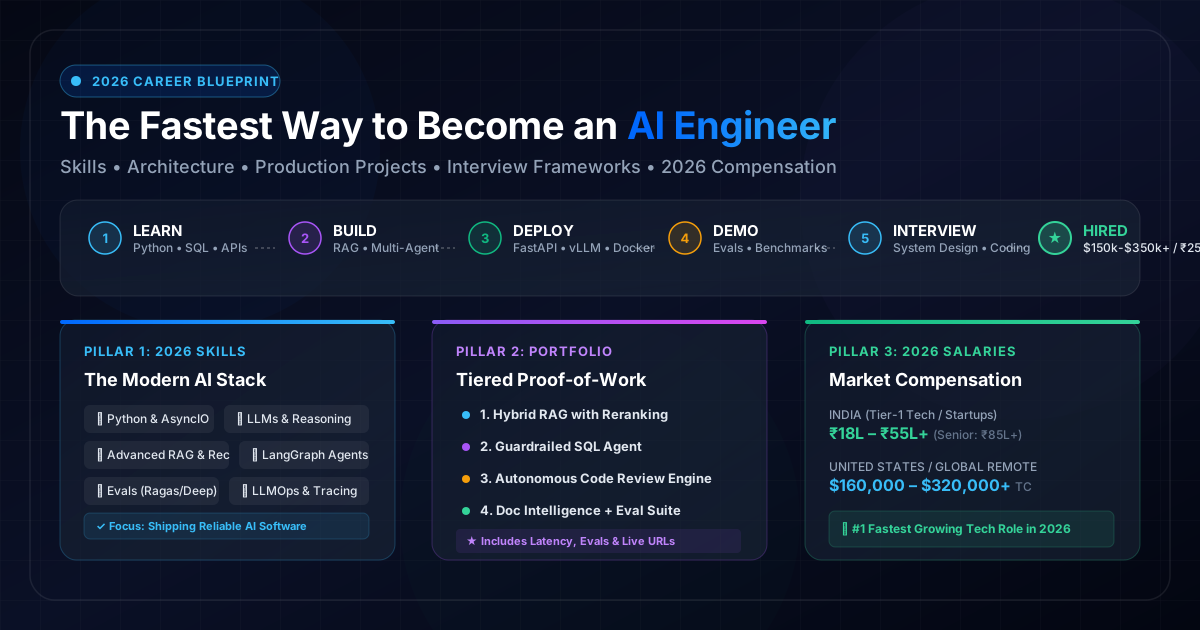
The top 1% of transitioning developers break in within 90 to 180 days using the 6-Stage Career Flywheel:
Notice the sequence: you do not wait until step 5 to build. You build while learning, deploy immediately, and let your public proof-of-work generate interview inbound before you even submit formal applications.
3. The Prioritized 2026 AI Engineer Tech Stack
To avoid tool fatigue, let's dissect the production AI engineering stack into 5 discrete, high-leverage layers. If a technology doesn't directly solve an engineering challenge in one of these layers, ignore it for now.
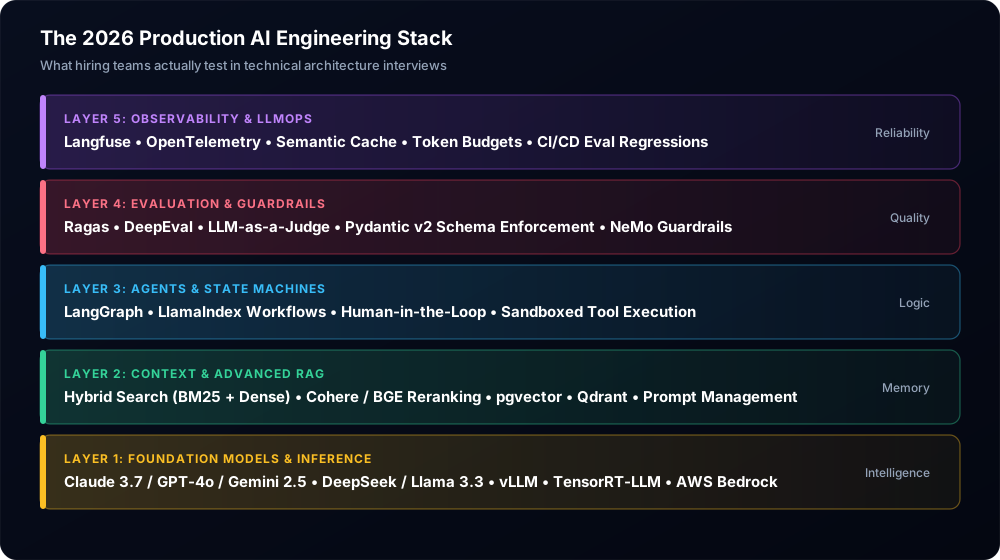
3.1 Layer 1: Modern Python 3.12+ & Data Engineering Foundations
Python is the lingua franca of AI, but modern AI engineering demands more than basic scripting. In production, LLMs stream tokens asynchronously, return structured payloads, and interface with microservices.
- Python 3.12+ & AsyncIO: Concurrency is mandatory. When querying 4 different LLM tools simultaneously or streaming Server-Sent Events (SSE) to a client, blocking synchronous code destroys throughput.
- Pydantic v2 & Type Annotations: LLMs are probabilistic, but software requires deterministic contracts. Pydantic v2 powers structured output validation, JSON schema generation for tool use, and data parsing.
- FastAPI & Streaming: Building async REST and WebSocket APIs with SSE token streaming, background task queues, and rate limiting.
- SQL & Vector Databases: Relational SQL remains undefeated. Combined with extensions like
pgvectorin PostgreSQL, or dedicated vector databases (Qdrant, Milvus, Chroma), you must understand HNSW indexing, cosine similarity, and metadata filtering.
3.2 Layer 2: Foundation Models, Token Economics & Context Engineering
In 2026, working with LLMs is far beyond writing casual chat prompts. It is about Context Engineering:
- Model Landscape & Trade-offs: Knowing when to route queries to frontier reasoning models (o3-mini, Claude 3.7 Sonnet Thinking, Gemini 2.5 Pro) vs fast edge-inference models (DeepSeek-V3, Llama 3.3 70B, Gemma 2) based on cost, latency, and reasoning depth.
- Structured Outputs & Function Calling: Using JSON schema enforcement (OpenAI Structured Outputs, Anthropic Tool Calling) to turn natural language into validated database writes, API triggers, and automated actions.
- Prompt Caching & Token Economics: Leveraging Anthropic and OpenAI prompt caching to reduce input latency by 80% and API costs by up to 90% on massive reference contexts.
- Delimiter Sandboxing & Security: Isolating untrusted user inputs using XML/Markdown delimiters to prevent prompt injection attacks and contextual hijacking.
3.3 Layer 3: Advanced RAG (Retrieval-Augmented Generation)
Naive RAG (taking a PDF, splitting into 500-token chunks, vector searching, and dumping into an LLM) fails in enterprise settings. A 2026 AI Engineer must master Advanced RAG:
| RAG Component | Naive RAG (Obsolete) | Production Advanced RAG (2026 Standard) |
|---|---|---|
| Chunking Strategy | Fixed character count (e.g. 500 chars) | Semantic chunking, recursive markdown parsing, table-aware AST chunking |
| Retrieval Mechanism | Dense vector search only (Cosine distance) | Hybrid Search: Dense embeddings + Sparse BM25 combined via Reciprocal Rank Fusion (RRF) |
| Post-Processing | Pass top-5 vectors directly to LLM | Cross-Encoder Reranking (Cohere Rerank 3.5, BGE-Reranker-Large) to reorder by relevance |
| Context Enrichment | Isolated chunk snippets | Contextual Retrieval (Anthropic style prepending document summaries) & Small-to-Big chunk expansion |
| Document Ingestion | Raw text extraction | Multimodal OCR (Docling, ColPali) preserving tables, figures, and hierarchical layout headers |
3.4 Layer 4: Agentic Systems & Deterministic State Machines
Autonomous "run-forever" agent loops frequently get stuck in hallucinations or burn $50 in API credits on infinite recursion. In 2026, production agents use deterministic state graphs:
- LangGraph & LlamaIndex Workflows: Representing agentic workflows as explicit Directed Acyclic Graphs (DAGs) and cyclical state machines with strictly typed state schemas, branching conditions, and rollback capabilities.
- Human-in-the-Loop (HITL): Halting execution on high-consequence actions (e.g. database deletions, financial transactions, email dispatch) to request human approval.
- Tool Sandboxing: Executing generated code in secure isolated environments (Docker containers, E2B, Modal sandboxes) rather than running unverified scripts on host servers.
- Multi-Agent Collaboration: Coordinating specialized agents (e.g., Planner → Coder → Tester → Reviewer) with explicit message passing and critique cycles.
3.5 Layer 5: Automated Evaluations (Evals) & LLMOps
This is the single biggest differentiator between amateur hobbyists and senior engineers. If you cannot quantitatively measure whether a prompt or code change made your system better or worse, you cannot engineer it.
- LLM-as-a-Judge & Eval Frameworks: Utilizing frameworks like Ragas and DeepEval to calculate objective metrics:
- Faithfulness: Is the answer grounded strictly in retrieved context without hallucination?
- Answer Relevance: Does the response directly address the user query?
- Context Precision & Recall: Did the retriever fetch the exact relevant ground-truth facts?
- LLM Observability & Tracing: Integrating tools like Langfuse, Arize Phoenix, or OpenTelemetry to inspect token latencies, step-by-step agent traces, cost per session, and error rates in real time.
- Inference Engines & Deployment: Serving open-weight models (Llama 3.3, DeepSeek, Qwen 2.5) using high-throughput inference runtimes like vLLM with PagedAttention, TensorRT-LLM, or managed services like AWS Bedrock and GCP Vertex AI.
- CI/CD Regression Gates: Automatically running an evaluation suite of 100 golden test cases in GitHub Actions before merging any prompt or pipeline update to production.
4. The 4 Tiered Portfolio Projects That Get You Hired
Resume recruiters and engineering managers in 2026 review hundreds of applications containing generic "PDF Chatbots with LangChain and Streamlit." These generic clones are instantly rejected because they show zero understanding of software engineering, evaluations, or production edge cases.
To stand out, build these 4 portfolio projects that increase progressively in complexity. Each project is designed to prove a specific tier of engineering maturity.
The Problem: Enterprise internal wikis and compliance handbooks contain dense legal jargon, complex markdown tables, and unstructured PDFs where traditional semantic vector search yields incomplete or hallucinated answers.
Architectural Blueprint:
Ingest PDF/DOCX files → Table-aware semantic chunking with metadata tags → Generate dense embeddings & BM25 sparse index → Dual hybrid retrieval → Reciprocal Rank Fusion → Cross-Encoder reranking → GPT-4o / Claude 3.7 streaming generation with inline bracket citations [Doc A, p. 12].
The Problem: Non-technical executives need instant SQL analytics from a 50-table production database, but raw LLM Text-to-SQL generates invalid joins, leaks restricted PII columns, or attempts destructive DROP/UPDATE queries.
Architectural Blueprint:
User natural query → Schema Context Pruning (retrieving only relevant tables via embeddings) → LLM SQL generation in read-only transaction → AST SQL validation (rejecting non-SELECT statements and PII columns) → Automated SQL syntax error self-correction loop → Execute query → Generate summary explanation with auto-rendered Chart.js graphs.
The Problem: Software engineering teams drown in PR backlog. Static linters miss business logic flaws, race conditions, and OWASP Top-10 security vulnerabilities.
Architectural Blueprint:
GitHub PR Webhook triggers LangGraph workflow → Diff Analyzer Agent extracts changed AST nodes → Security Agent scans for prompt injection, hardcoded secrets, and SQLi → Test Generation Agent writes pytest unit tests → Execution Sandbox Agent runs tests inside an ephemeral Docker container → Synthesizer Agent posts line-by-line GitHub PR comments with suggested diff fixes.
The Problem: Investment analysts and regulatory audit teams spend 20+ hours comparing quarterly 10-K SEC filings, audit spreadsheets, and earnings transcripts across multiple fiscal quarters to identify conflicting disclosures.
Architectural Highlights:
- Multimodal Ingestion: Handles complex financial tables, balance sheets, and charts without losing structural row/column alignment.
- Semantic Cache Layer (Redis): Caches frequently asked regulatory queries with cosine threshold > 0.96, reducing average latency from 3.2s to 45ms and saving 40% API token costs.
- Automated Regression Pipeline: 120 curated golden financial Q&A evaluation dataset run on every Git commit via GitHub Actions using DeepEval. Builds fail if G-Eval accuracy drops below 92%.
- Production Observability: Real-time dashboard showing token throughput (tokens/sec), p95/p99 latency, cost per user session, and user feedback thumbs up/down feedback logging.
5. The 5 Fatal Mistakes That Keep Developers Trapped
Thousands of smart engineers spend months studying AI without ever landing an interview because they fall into these common 2026 traps:
A 30-line Python script wrapped in Streamlit that connects to OpenAI's completion endpoint is a toy, not a portfolio piece. It has no user authentication, no database persistence, no streaming latency optimization, no automated evaluations, and no error handling. Build decoupled backends (FastAPI) and real client interfaces.
Relying on manual "vibes" to test your AI application (testing 3 sample questions in your terminal and assuming it works) is the fastest way to get disqualified in technical interviews. Engineering managers want to see test datasets, precision/recall metrics, and automated regression suites.
Setting up 8 autonomous agents that debate each other in circles when a single well-structured prompt with few-shot examples or a deterministic Python function would solve the problem faster and for 1/100th the cost. In 2026, pragmatism is a superpower.
If your RAG pipeline takes 18 seconds to answer a single question because you make 5 sequential non-cached LLM calls, it will never survive production traffic. You must understand token budgets, semantic caching, async parallel tool execution, and prompt caching.
Never expose your provider API keys in frontend bundles or client-side code. Implement secure proxy backends with rate limiting, input sandboxing, and output moderation guardrails.
6. Realistic Timelines: The 90-Day Sprint vs 6-Month Roadmap
Your roadmap depends on your starting baseline:
| Track | Ideal For | Weekly Commitment | Total Duration | Expected Outcome |
|---|---|---|---|---|
| The 90-Day High-Velocity Sprint | Existing Software Engineers, Backend/Full-Stack Developers, CS Graduates | 15–20 hours / week | 3 Months (12 Weeks) | Job-ready for Mid-to-Senior AI Engineer roles |
| The 6-Month Comprehensive Journey | Beginners, Non-CS Career Switchers, Data Analysts moving to Engineering | 12–15 hours / week | 6 Months (24 Weeks) | Job-ready for Junior-to-Mid AI Engineer roles |
The 90-Day Sprint: Week-by-Week Execution Plan
asyncio, Pydantic v2 schemas, OpenAI/Anthropic APIs, token counting, structured JSON outputs, and function calling. Build simple CLI tools that query LLM tools with strict schema validation.
pgvector and Qdrant. Implement semantic chunking, BM25 + dense hybrid search, Reciprocal Rank Fusion, and Cohere rerankers. Build & Ship Portfolio Project 1 (Enterprise Hybrid RAG) with FastAPI SSE streaming.
7. The 2026 AI Engineer Interview Blueprint
AI engineering interviews differ significantly from traditional LeetCode grinds. Top companies assess 4 practical engineering pillars:
8. 2026 AI Engineer Salaries & Market Compensation Data
Because of the severe shortage of engineers who can ship reliable production AI software, AI Engineers command significant compensation premiums across global tech hubs.
| Experience Level | India (INR / Year) | United States (USD Total Comp) | Europe & UK (EUR / GBP) | Global Remote |
|---|---|---|---|---|
| Junior AI Engineer 0–2 Years Exp / Strong Portfolio |
₹8,00,000 – ₹18,00,000 | $110,000 – $150,000 | €50,000 – €70,000 (£45k – £65k) |
$80,000 – $120,000 |
| Mid-Level AI Engineer 2–5 Years Exp / Production Shipped |
₹18,00,000 – ₹38,00,000 | $150,000 – $220,000 | €75,000 – €120,000 (£70k – £110k) |
$120,000 – $180,000 |
| Senior AI Engineer 5+ Years / System Architecture & Evals |
₹40,00,000 – ₹65,00,000 | $230,000 – $340,000 | €125,000 – €180,000 (£115k – £165k) |
$180,000 – $260,000 |
| Staff / Lead AI Architect Cross-Team Leadership, Infra & LLMOps |
₹65,00,000 – ₹85,00,000+ | $340,000 – $480,000+ | €180,000 – €240,000+ (£165k – £220k+) |
$250,000 – $380,000+ |
*Sources: Aggregated from 2026 hiring benchmarks, Levels.fyi reports, startup equity packages, and tier-1 Indian product companies (Bangalore/Hyderabad/Gurgaon).
9. Supercharging Your Prompt Engineering with Promptnote
As an AI Engineer, prompt and context templates are your codebase. When you iterate on multi-step system prompts, evaluation benchmarks, or complex few-shot instructions, losing your winning prompt variations or retyping them across VS Code, Cursor, terminal windows, and web consoles kills your velocity.
This is why top AI engineers use Promptnote — a blazing-fast, privacy-first Windows desktop prompt manager designed to streamline your development workflow.
- Global Hotkey Quick Picker (Ctrl+Shift+P): Instantly summon your curated prompt templates, few-shot schemas, and system instructions from any IDE, terminal, or browser window.
- Local-First & Version Controlled: Keep your prompt iterations organized in tagged collections without recurring cloud fees or third-party telemetry.
- One-Time Purchase ($12.00): Zero monthly subscription fees, pure speed, and lifetime local utility.
10. Frequently Asked Questions (FAQ)
What is the single most important skill to learn first in 2026?
Structured Outputs & Function Calling in Python. Learning how to reliably force LLMs to return strict, typed Pydantic objects and execute functions unlocks both advanced RAG and autonomous agents. Without structured outputs, LLMs remain conversational toys rather than software building blocks.
Should I learn LangChain or build raw API pipelines?
Start by writing raw API client calls with the official OpenAI/Anthropic Python SDKs so you understand underlying HTTP payloads, token counts, and error codes. Once you understand the mechanics, adopt LangGraph for complex state machines or LlamaIndex for advanced data retrieval. Avoid heavy monolithic abstractions that hide what happens under the hood.
Is fine-tuning dead in 2026?
Fine-tuning is not dead, but it is rarely your first step. In 2026, 90% of use cases are solved significantly better, faster, and cheaper using Few-Shot Context Engineering + Advanced Hybrid RAG. Fine-tuning (LoRA/QLoRA) is reserved for teaching a model a specific formatting style, domain vocabulary, or distilling a large model into a smaller, cheaper 3B/7B edge model.
How can I prove my portfolio is legitimate and not AI-generated code?
Include an architecture diagram, record a concise 2-minute Loom/video walkthrough explaining the engineering trade-offs you made, publish automated eval test results (Ragas/DeepEval), and write comprehensive technical documentation explaining why you chose specific chunking strategies, vector indexes, and rerankers.
What if I don't have a Computer Science degree?
The AI industry in 2026 cares overwhelmingly about verifiable proof-of-work. A candidate with no degree who has deployed a live, observable multi-agent system with automated eval benchmarks will consistently beat a CS graduate with only course notes on their resume.
11. Sources & Reliable References
- Anthropic Research (2025). Contextual Retrieval: Improving RAG Accuracy with Contextual Embeddings & BM25 Hybrid Search.
- OpenAI Developer Platform (2025). Structured Outputs & Deterministic Function Calling Architecture.
- Es, S., et al. (2024). Ragas: Automated Evaluation of Retrieval Augmented Generation. arXiv:2309.15217.
- LangChain / LangGraph Team (2025). Building Reliable Multi-Agent Applications with Stateful Graph Architectures.
- Levels.fyi & Tech Compensation Reports (2026). Global AI & Machine Learning Engineering Salary Benchmarks.
Related Guides & Deep Dives
Continue exploring modern AI engineering, career blueprints, and developer workflows across Promptnote:
How to Write the Best Prompt: Masterclass
Master the C.R.E.A.T.E. framework, eliminate hallucinations with delimiters, and explore 15+ before-and-after transformations.
Read Guide →Forward-Deployed Engineer (FDE) Guide
Discover what FDEs do, why AI labs pay $300k–$500k+, differences with SWEs & Solutions Architects, and career paths.
Read Guide →What Is Vibe Coding? The Complete Guide
Explore how natural language intent and AI coding agents build complete applications without manual line-by-line syntax.
Read Guide →