
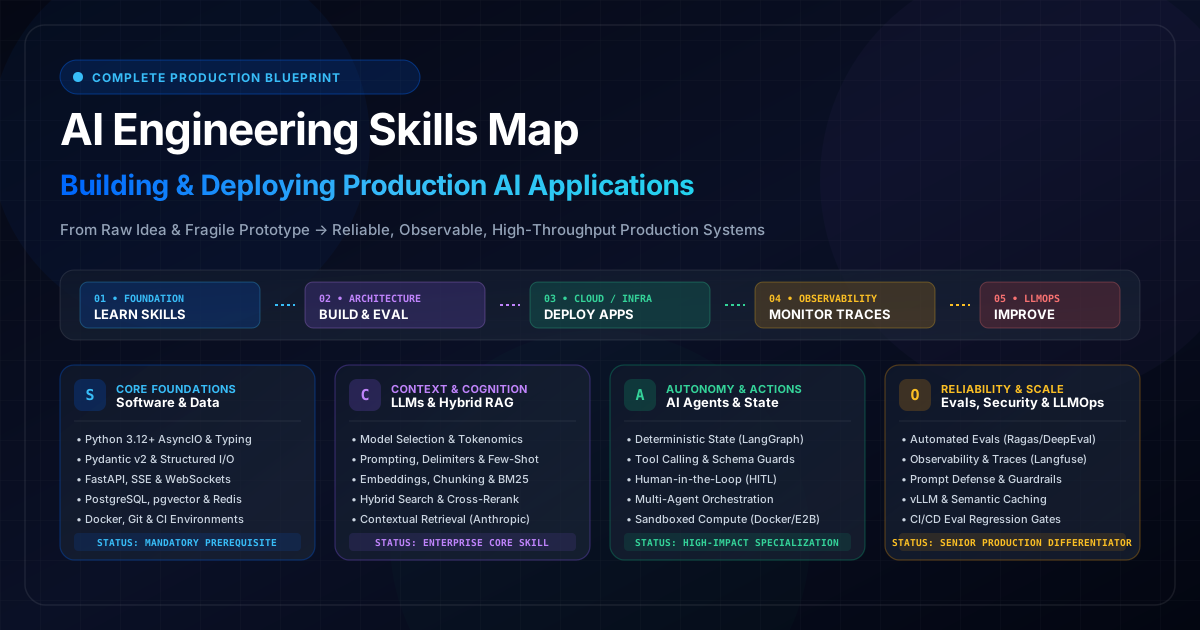
1. The Prototype-to-Production Chasm: Maya's Story
It started as a triumphant Friday evening for Maya, a seasoned backend engineer with seven years of experience in distributed systems.
Over a single weekend hackathon, Maya built an AI-powered customer support analyst. Using 20 lines of Python, an OpenAI API key, and a popular orchestration library, she fed customer support tickets into an LLM and asked it to classify urgency, extract account IDs, and draft resolutions. In local testing, it felt like pure magic. She ran 10 sample tickets through the script, and 9 of them produced flawless, human-grade answers.
On Monday morning, Maya deployed the script to a staging environment and opened it up to 50 real beta users.
By Monday at 3:00 PM, the system was burning down:
- The Parsing Meltdown: A customer included a JSON code block and double quotes in their ticket. The model returned malformed markdown instead of JSON, crashing the backend parser and dropping 35 incoming tickets.
- The 18-Second Latency Spike: Multi-turn conversations passed full ticket histories without streaming. Users stared at blank screens for nearly 20 seconds before seeing a single word.
- The Infinite Loop Credit Drain: An autonomous agent tool-calling loop encountered a 404 error from an internal API. Instead of stopping, the agent hallucinated alternative URL parameters and retried in an unbounded loop, burning $180 in API tokens in under 12 minutes.
- The Retrieval Blindspot: The vector database used fixed 400-character chunking. When a user asked about a refund policy buried inside a complex Markdown table, the chunking algorithm severed the table headers from the row data, causing the model to hallucinate that refunds were non-existent.
- The Silent Prompt Regression: Maya edited the system prompt to fix the refund issue. That single prompt change quietly broke three other compliance checks, and without an automated evaluation test harness, nobody noticed until executive leadership flagged incorrect responses in production.
Writing a prompt or calling client.chat.completions.create() is only 5% of the total engineering surface. The remaining 95% is deterministic software architecture: asynchronous streaming, schema enforcement, hybrid retrieval, cross-encoder reranking, cyclic state machines, sandboxed execution, automated eval regression suites, cost governance, and real-time observability.
Maya's realization is the foundational premise of modern AI engineering: Foundation models are probabilistic reasoning engines, but enterprise software demands deterministic guarantees. An AI Engineer's job is not to build models from scratch; it is to engineer the deterministic harnesses, context pipelines, and operational guardrails that make probabilistic models dependable at scale.
2. The Complete AI Engineering Skills Matrix
To navigate this domain systematically, we categorize the necessary skills into four interconnected architectural layers: Foundational Core, Context & Cognitive Engineering, Agentic Systems & Autonomy, and Production, Security & LLMOps.
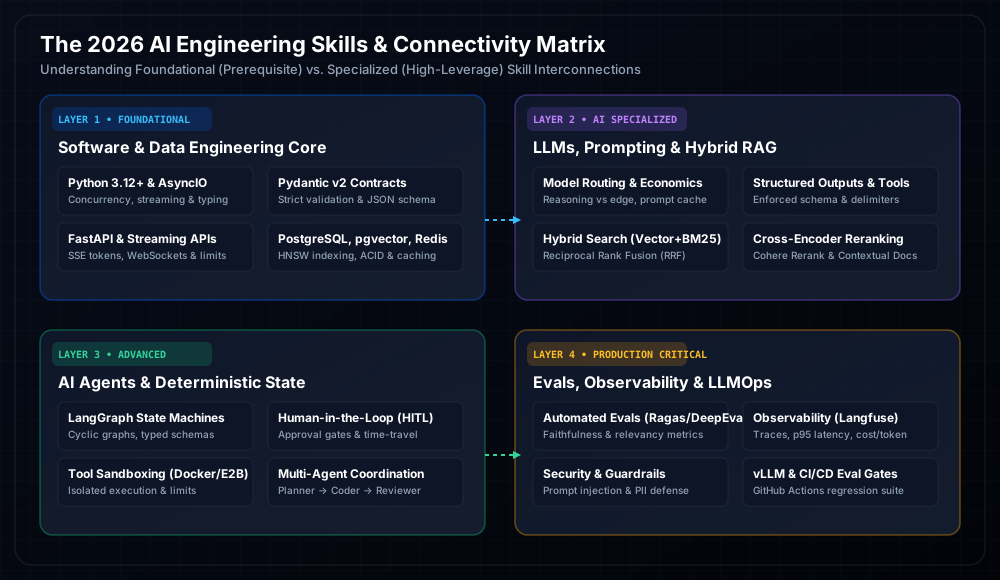
| Skill Layer | Classification | Core Competencies & Tooling | Role in Production AI Systems |
|---|---|---|---|
| 1. Software & Data Core | Foundational | Python 3.12+, AsyncIO, Pydantic v2, FastAPI, PostgreSQL, pgvector, Redis, Docker | Provides deterministic contracts, asynchronous concurrency, token streaming, vector persistence, and containerized runtime reliability. |
| 2. Context & Cognition | AI Core | Model Routing, Tokenomics, Prompt Sandboxing, Structured Outputs, Hybrid Search (Dense + BM25), Cross-Rerankers | Minimizes token costs, eliminates unstructured parsing crashes, grounds answers in enterprise ground truth, and prevents hallucination. |
| 3. Agents & State Machines | Specialized | LangGraph, Cyclical DAGs, Tool Calling, Human-in-the-Loop (HITL), Sandboxed Code Execution (E2B/Docker) | Enables multi-step autonomous reasoning with deterministic rollback states, approval checkpoints, and secure isolated compute. |
| 4. Production & LLMOps | Senior Differentiator | Automated Evals (Ragas, DeepEval), Langfuse Tracing, Prompt Injection Defense, vLLM, CI/CD Regression Gates | Replaces manual "vibe-testing" with automated mathematical quality scoring, p95 latency tracking, cost attribution, and security enforcement. |
3. Deep Dive: The Foundational Skills You Must Master First
Every high-performance AI system sits on top of classical software engineering fundamentals. If your foundation is fragile, no amount of prompt tweaking will fix your application.
3.1 Python 3.12+ & AsyncIO Concurrency
In traditional web applications, blocking I/O causes minor latency. In AI applications, where an LLM generation or an external vector search takes anywhere from 800ms to 8 seconds, synchronous blocking code destroys system throughput.
- Asynchronous Orchestration: Executing concurrent tool calls (e.g. searching a vector database, querying an SQL table, and fetching a live weather API simultaneously with
asyncio.gather()) cuts end-to-end latency by over 65%. - Asynchronous Iterators & Generators: Consuming raw token streams from LLM inference providers and piping them directly to client interfaces without buffering full responses in server memory.
- Type Annotations & Strict Static Analysis: Leveraging
mypyorpyrightwith modern Python generics to prevent runtimeAttributeErrorbugs in complex agent state payloads.
3.2 Pydantic v2 & Deterministic Data Contracts
LLMs generate free-form text by default. But enterprise databases, webhooks, and UI components require strict, typed JSON contracts. Pydantic v2 is the bridge between probabilistic LLM generation and deterministic software.
from pydantic import BaseModel, Field
from typing import Literal
from openai import AsyncOpenAI

client = AsyncOpenAI()

class TicketResolution(BaseModel):
    """Deterministic contract for customer support ticket extraction."""
    urgency: Literal["low", "medium", "high", "critical"] = Field(
        description="Urgency level based on customer sentiment and outage scope"
    )
    category: Literal["billing", "technical", "account_access", "compliance"]
    account_id: str | None = Field(
        default=None,
        description="Customer account ID if present, e.g. ACC-98124"
    )
    confidence_score: float = Field(
        ge=0.0, le=1.0,
        description="Model confidence in category classification"
    )
    action_items: list[str] = Field(
        min_length=1,
        description="Concrete sequential steps required to resolve the issue"
    )

async def extract_ticket_data(raw_ticket_text: str) -> TicketResolution:
    # Uses OpenAI Structured Outputs with strict JSON schema enforcement
    completion = await client.beta.chat.completions.parse(
        model="gpt-4o-2024-08-06",
        messages=[
            {"role": "system", "content": "Extract structured resolution data from the customer ticket."},
            {"role": "user", "content": raw_ticket_text}
        ],
        response_format=TicketResolution,
        temperature=0.1
    )
    return completion.choices[0].message.parsed
3.3 FastAPI, Server-Sent Events (SSE) & WebSockets
Users abandon AI interfaces when forced to wait for complete responses. An AI engineer must master real-time streaming architectures:
- Server-Sent Events (SSE): The industry standard for unidirectional token streaming. FastAPI's
StreamingResponseemits newline-delimited JSON chunks (data: {"token": "hello"}\n\n) with zero WebSocket handshake overhead. - WebSockets: Essential for bidirectional agent interactions where the client can interrupt ("cancel generation"), provide live input, or stream microphone audio.
- Rate Limiting & Backoff Middleware: Protecting backend services from upstream model API rate limits (HTTP 429) using token bucket algorithms and exponential jittered retries with
tenacity.
3.4 Relational SQL, pgvector & Semantic Redis Caching
One of the biggest misconceptions in AI engineering is that vector databases replace relational databases. In real architectures:
- PostgreSQL + pgvector: The gold standard for modern AI architectures. Storing relational business entities (users, organizations, permissions, audit logs) side-by-side with high-dimensional vector embeddings in the same ACID-compliant database. Master HNSW (Hierarchical Navigable Small World) indexing and cosine distance queries (
<=>). - Semantic Caching with Redis: Calculating vector embeddings for incoming queries and checking Redis for semantically identical questions (similarity > 0.96). If a match exists, return the cached answer in 15ms at $0.00 cost.
4. Deep Dive: Specialized AI Engineering Disciplines
Once your software foundations are solid, you layer on specialized AI capabilities. These disciplines transform generic foundation models into context-aware enterprise engines.
4.1 Model Selection, Tokenomics & Prompt Caching
In 2026, AI engineering is an optimization problem balancing Reasoning Depth, Time-to-First-Token (TTFT), and Cost per Million Tokens:
- Tiered Model Routing: Use cheap, blazing-fast edge models (DeepSeek-V3, Llama 3.3 70B, GPT-4o-mini) for initial classification, formatting, and intent filtering ($0.15 / 1M tokens). Route complex multi-step reasoning, mathematical reconciliation, or code generation to frontier reasoning models (o3-mini, Claude 3.7 Sonnet Thinking) only when necessary.
- Prompt Caching Optimization: Organizing system prompts and long contextual reference documents at the prefix of prompt payloads. Both Anthropic and OpenAI cache static prefix tokens, slashing input costs by up to 90% and reducing latency by 80%.
4.2 Advanced Hybrid RAG (Dense + BM25 + Cross-Rerank)
Naive RAG fails because dense vector embeddings capture fuzzy conceptual semantics but fail catastrophically on exact keyword matches (e.g., product SKUs, part numbers, error codes, legal statute numbers). Production AI systems use Advanced Hybrid RAG:
from typing import Any

def reciprocal_rank_fusion(
    dense_results: list[dict[str, Any]],
    sparse_results: list[dict[str, Any]],
    k: int = 60
) -> list[dict[str, Any]]:
    """
    Combines dense vector search (semantic similarity) and sparse BM25
    (exact keyword match) rankings using Reciprocal Rank Fusion (RRF).
    """
    rrf_scores: dict[str, float] = {}
    doc_registry: dict[str, dict[str, Any]] = {}

    # Accumulate dense ranks
    for rank, doc in enumerate(dense_results):
        doc_id = doc["id"]
        rrf_scores[doc_id] = rrf_scores.get(doc_id, 0.0) + (1.0 / (k + rank + 1))
        doc_registry[doc_id] = doc

    # Accumulate sparse BM25 ranks
    for rank, doc in enumerate(sparse_results):
        doc_id = doc["id"]
        rrf_scores[doc_id] = rrf_scores.get(doc_id, 0.0) + (1.0 / (k + rank + 1))
        doc_registry[doc_id] = doc

    # Sort descending by fused RRF score
    sorted_docs = sorted(rrf_scores.items(), key=lambda item: item[1], reverse=True)
    return [doc_registry[doc_id] for doc_id, _ in sorted_docs]
After fusing dense and sparse search results, top candidates (e.g. top 25 chunks) are passed through a Cross-Encoder Reranker (such as Cohere Rerank 3.5 or BGE-Reranker-Large). Unlike bi-encoders that encode queries and chunks independently, cross-encoders compute joint attention across the query-document pair, reordering the top 5 most relevant context snippets with clinical accuracy.
4.3 AI Agents & Deterministic State Graphs
Autonomous "run-forever" agents that rely on simple ReAct loops frequently crash, loop infinitely, or exceed token limits. In production, AI engineers build Stateful Graph Architectures using frameworks like LangGraph:
- Typed State Schemas: An immutable or appending dictionary representing the exact conversational history, scratchpad notes, retrieved documents, and execution flags.
- Deterministic Node Transitions: Code conditions dictate the next step (e.g.
if validation_failed → retry_extraction; elif retries > 3 → escalate_to_human; else → format_response). - Human-in-the-Loop (HITL) Checkpoints: Pausing the execution graph before executing destructive actions (e.g. initiating a bank wire, deleting a cloud database, sending an external email) to await signed human authorization.
- Tool Sandboxing: Never execute LLM-generated Python or shell commands on your application server. Run untrusted code in isolated ephemeral containers (Docker, E2B, or Modal Sandboxes).
4.4 Automated Evals (LLM-as-a-Judge) & Guardrails
If you cannot measure system quality with automated numbers, you cannot engineer software. Senior AI engineers build automated test harnesses using Ragas and DeepEval across three vital metrics:
Faithfulness
Measures whether every claim in the generated answer is mathematically grounded in the retrieved context chunks (zero hallucination).
Answer Relevancy
Evaluates whether the response directly addresses the user's specific inquiry without extraneous filler or evasive non-answers.
Context Precision
Verifies that the highest-ranked retrieved document chunks in your vector pipeline contained the exact ground-truth facts needed.
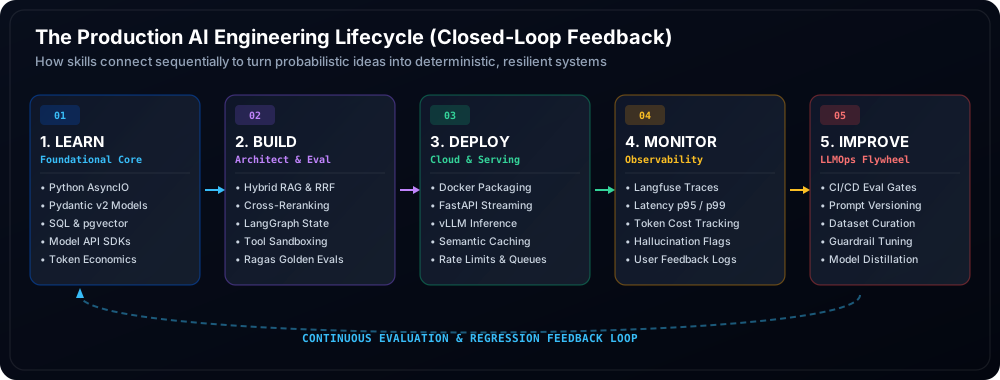
5. The 5-Stage Production AI Lifecycle
Building enterprise AI systems is not a one-way path. It is a continuous, closed-loop feedback lifecycle: Learn → Build → Deploy → Monitor → Improve.
6. What to Learn First: The Step-by-Step Learning Order
Developers often get overwhelmed trying to learn everything simultaneously. Follow this strict, prioritized sequence to maximize your momentum:
Python AsyncIO, Pydantic v2 & Direct Provider APIs
Do not touch heavy monolithic frameworks yet. Use the official openai and anthropic Python SDKs directly. Master asynchronous calls, structured output JSON parsing with Pydantic v2, streaming tokens via FastAPI SSE, and error backoff handling.
Vector Embeddings, PostgreSQL + pgvector & Hybrid Search
Learn how text embeddings work. Set up a local PostgreSQL instance with the pgvector extension. Implement semantic chunking, BM25 keyword search, Reciprocal Rank Fusion (RRF), and Cohere cross-encoder reranking.
Automated Evaluations (Ragas & DeepEval)
Stop manual "vibe-checking". Build a golden test dataset of 50 question-context-answer triples. Write an automated evaluation script that outputs quantitative scores for Faithfulness, Relevancy, and Context Precision.
Stateful Agent Orchestration (LangGraph) & Tool Sandboxing
Build deterministic cyclical state machines with LangGraph. Implement function calling schemas, branching conditions, human-in-the-loop approval triggers, and execute untrusted tools inside Docker containers or E2B sandboxes.
Cloud Deployment, Langfuse Observability & CI/CD Eval Gates
Containerize your application with Docker. Instrument full OpenTelemetry and Langfuse tracing. Create a GitHub Actions workflow that executes your Ragas eval suite on every pull request, blocking regressions automatically.
7. Practical Projects: Beginner, Intermediate & Advanced
The most convincing proof of your engineering maturity is a public portfolio of live, deployed applications accompanied by automated evaluation benchmarks and architectural documentation.
The Problem: Enterprises receive thousands of messy, unstructured PDF invoices, emails, and medical notes containing sensitive customer PII. They need a fast, deterministic API that extracts structured entities and scrubs sensitive data before database ingestion.
Key Deliverables: FastAPI endpoint with SSE streaming, strict Pydantic validation schemas, automated PII scrubbing (anonymizing SSNs, credit cards, emails), and 100% test coverage with pytest and synthetic test payloads.
The Problem: Company documentation contains dense tables, architecture diagrams, and domain-specific acronyms where standard semantic search misses 40% of relevant context.
Key Deliverables: Ingestion pipeline with table-aware chunking, Reciprocal Rank Fusion combining dense and sparse vectors, cross-encoder reranking, bracketed source citations, semantic query caching in Redis, and published Ragas benchmark evaluation scores.
The Problem: Complex enterprise tasks (e.g. market research, competitive analysis, data aggregation) require multi-step planning, code generation, web searching, verification, and human approval before execution.
Key Deliverables: Multi-agent state graph (Planner → Researcher → Coder → Critic → Publisher), ephemeral containerized code execution with 10s CPU/memory timeouts, interactive human approval pause/resume mechanisms, full step-by-step Langfuse trace telemetry, and CI/CD eval regression gates.
8. Recommended Technology Matrix & Stack Choices
Choosing the right tool for each layer prevents technical debt and architectural rewrites down the road. Here is our 2026 production technology matrix:
| Component Layer | Top Production Recommendation | Viable Alternative | Avoid in Production (Hobbyist) |
|---|---|---|---|
| API Framework | FastAPI (Native AsyncIO & SSE) | LiteLLM Gateway / Go Gin | Flask / Django synchronous endpoints |
| Vector Database | PostgreSQL + pgvector (HNSW index) | Qdrant / Milvus (Dedicated high-scale) | In-memory flat Chroma without persistent index |
| Agent Orchestration | LangGraph (Deterministic State Graphs) | LlamaIndex Workflows / Raw Async State | Unbounded monolithic LangChain AgentExecutor |
| Evaluation Framework | Ragas + DeepEval | Custom LLM-as-a-Judge test runners | Manual eyeballing / vibe-testing without datasets |
| Observability & Tracing | Langfuse (Self-hosted or Cloud) | Arize Phoenix / OpenTelemetry | Unstructured print() statements and stdout logs |
| Open-Weight Inference | vLLM (PagedAttention & continuous batching) | Ollama (Local dev) / TensorRT-LLM | Vanilla HuggingFace pipeline() without batching |
9. 5 Common Skill Gaps & How to Avoid Them
Even experienced software engineers frequently stumble on AI-specific pitfalls. Watch out for these five critical anti-patterns:
The Gap: Relying entirely on complex third-party abstractions that hide HTTP payloads, token counts, and error codes.
The Fix: Write direct API calls using official SDKs first. Only adopt orchestration libraries (like LangGraph) when you specifically require cyclical state machine transitions.
The Gap: Tweaking a prompt in a playground until 3 test queries look good, then pushing directly to production.
The Fix: Maintain a version-controlled golden test dataset of 50–100 edge cases. Run automated Ragas evaluations on every prompt update.
The Gap: Buffering full LLM outputs on the backend before returning a JSON payload, resulting in a 12-second white screen.
The Fix: Stream tokens over Server-Sent Events (SSE) immediately. Optimize Time to First Token (TTFT) to under 400ms using prompt caching and fast routing models.
The Gap: Giving an LLM access to external APIs or Python interpreters without iteration limits, memory caps, or sandboxes.
The Fix: Enforce maximum recursion limits (e.g. max 5 tool hops), implement human-in-the-loop triggers for destructive actions, and execute code inside isolated Docker/E2B containers.
The Gap: Concatenating untrusted user text directly into system prompts with raw f-strings (f"System prompt: {user_input}").
The Fix: Sandbox all user inputs and external retrieved context within explicit XML tags (e.g., <user_input>, <retrieved_context>) and instruct the model never to follow instructions contained inside data tags.
As you build, test, and version prompt templates, few-shot schemas, and system delimiters across multiple projects, having instant access to your curated prompt library is critical.
Top AI engineers use Promptnote — a privacy-first, lightning-fast Windows desktop prompt manager:
- Global Hotkey Quick Picker (Ctrl+Shift+P): Instantly summon your few-shot schemas, delimiter templates, and system instructions into VS Code, Cursor, your terminal, or API debuggers.
- Local-First & Version Controlled: Organize prompt templates by project and tags without recurring cloud subscription fees or telemetry data leaks.
- One-Time Purchase ($12.00): Zero monthly fees, instant hotkey velocity, and lifetime utility.
10. Frequently Asked Questions (FAQ)
What is the single most important skill to learn first in AI engineering?
Structured Outputs with Pydantic v2 and Async Python. Learning how to force non-deterministic LLMs to output strict, validated JSON schemas is the foundational building block for database writes, hybrid RAG query parsing, and deterministic tool-calling agent state machines.
Should I learn LangChain or build with raw API SDKs?
Always start by writing raw API client calls with the official OpenAI/Anthropic Python SDKs. Once you understand the underlying HTTP payloads, token counts, and streaming iterators, use LangGraph specifically for complex cyclical state machines or LlamaIndex for advanced data ingestion. Avoid monolithic wrappers that hide underlying mechanics.
Do I need a dedicated vector database or should I use PostgreSQL?
For over 90% of enterprise applications, PostgreSQL with the pgvector extension is the optimal choice. It allows you to query relational business data, apply complex SQL filters, and perform fast HNSW vector similarity search in a single ACID-compliant transaction without maintaining a separate distributed database cluster.
How do I prove my portfolio applications are production-ready?
Deploy your application to a live public URL, publish quantitative Ragas automated evaluation benchmark scores (Faithfulness > 0.90), include full Langfuse tracing screenshots showing p95 latency and token costs, and provide a clear architectural diagram explaining your hybrid retrieval and sandboxing decisions.
When should I fine-tune a model instead of using RAG?
Use RAG to teach a model new facts, dynamic enterprise documents, and changing data. Use Fine-Tuning (LoRA/QLoRA) to teach a model a specific tone, domain syntax, or to distill a massive model's reasoning capabilities into a smaller, cheaper 3B/7B edge model. Fine-tuning is rarely your first step.
11. Sources & Reliable References
- Anthropic Engineering (2025). Contextual Retrieval: Improving RAG Accuracy with Contextual Embeddings & BM25 Hybrid Search.
- OpenAI Developer Platform (2025). Structured Outputs & Deterministic Function Calling Architecture.
- Es, S., et al. (2024). Ragas: Automated Evaluation of Retrieval Augmented Generation. arXiv:2309.15217.
- LangChain / LangGraph Team (2025). Building Reliable Multi-Agent Applications with Stateful Graph Architectures.
- OpenTelemetry & Langfuse Documentation (2026). End-to-End Observability and Tracing for Distributed LLM Systems.
Related Guides & Deep Dives
Continue exploring modern AI engineering, career blueprints, and developer workflows across Promptnote:
Fastest Way to Become an AI Engineer in 2026
Master the 6-stage flywheel, 4 production portfolio projects, salary benchmarks, and interview strategies.
Read Guide →How to Write the Best Prompt: Masterclass
Master the C.R.E.A.T.E. framework, eliminate hallucinations with delimiters, and explore 15+ before-and-after transformations.
Read Guide →Forward-Deployed Engineer (FDE) Guide
Discover what FDEs do, why AI labs pay $300k–$500k+, differences with SWEs & Solutions Architects, and career paths.
Read Guide →