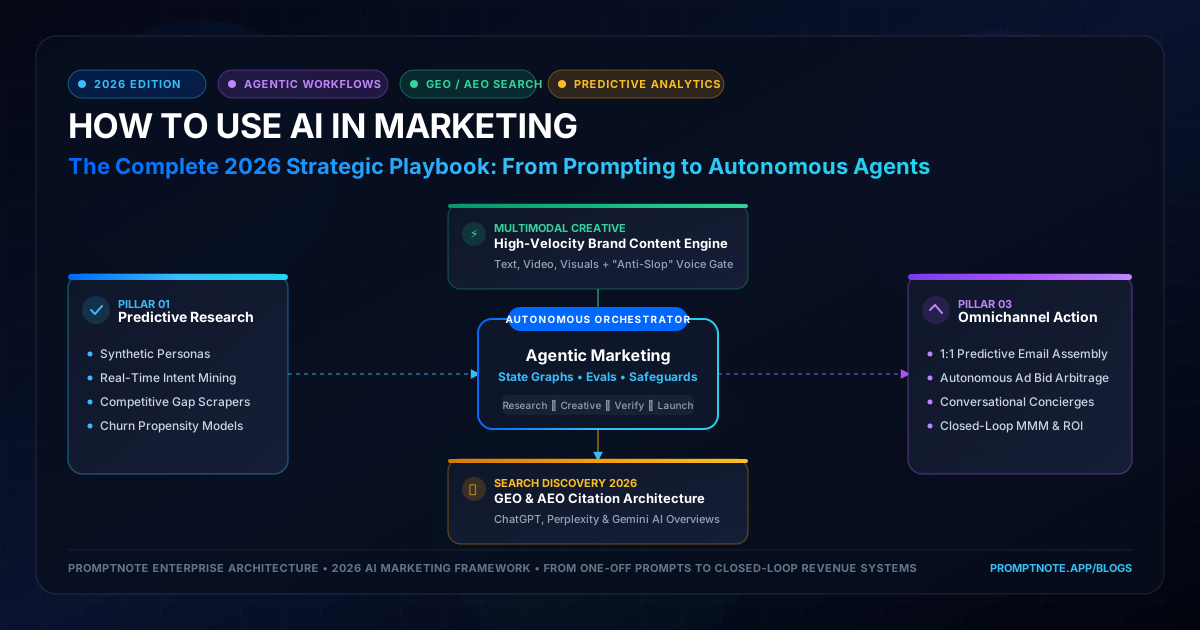
1. The Tale of Two Marketing Directors: Why 2024 AI Playbooks Fail in 2026
In January 2024, Elena and Marcus both served as VP of Marketing at competing B2B SaaS companies. Both recognized that artificial intelligence was transforming business, and both mandated immediate AI adoption across their 15-person teams.
Elena took the conventional path that 90% of marketing departments followed:
- She bought 15 enterprise ChatGPT and Midjourney subscriptions.
- She asked her copywriters to generate 10 blog posts a week instead of two.
- She encouraged her social team to draft endless variations of Twitter/X threads and LinkedIn carousels with AI.
- Her media buyers used AI to generate dozens of generic ad headlines.
By mid-2025, Elena’s strategy hit an unyielding brick wall. Her organic search traffic plummeted by 54% as search engines filtered out commoditized synthetic text. Customer engagement on email collapsed because every message felt like bland corporate filler. Her creative team was burned out—not from writing, but from spending five hours a day fixing disjointed hallucinations, awkward metaphors, and robotic phrasing. Worst of all, conversion rates on paid media cratered: their customer acquisition cost (CAC) jumped by 62%.
Marcus, meanwhile, took a fundamentally different approach. Instead of treating AI as a high-speed copywriter, he treated it as an operating infrastructure:
- He built a centralized repository of brand voice contracts, customer objection logs, and competitive positioning vectors.
- He shifted his team from single-turn prompts to closed-loop agentic workflows, where autonomous agents pulled real buyer intent data from sales transcripts, drafted multimodal assets, passed automated brand-safety checks, and deployed campaigns directly into testing environments.
- He restructured their content strategy for Generative Engine Optimization (GEO), ensuring their product was consistently cited as the primary recommendation in Perplexity, ChatGPT Search, and Google AI Overviews.
- He implemented predictive churn models that automatically assembled personalized retention offers in real time based on user telemetry.
By late 2026, Marcus’s team produced 4x higher pipeline revenue with the exact same headcount. Their brand citations in generative search grew by 310%, and their customer acquisition cost dropped by 38%.
The question in 2026 is no longer "Can AI write this email or blog post for me?" In an ecosystem flooded with synthetic copy, raw generative output has zero economic value. The winning question is: "How do we orchestrate autonomous intelligence across our strategy, research, creative, search, and distribution loops to deliver defensible business advantage?"
2. From Isolated Prompts to Agentic Marketing: The 2026 Paradigm Shift
Recent 2026 industry research reveals a decisive inflection point: over 78% of forward-thinking marketing organizations have graduated from isolated point tools to integrated agentic marketing systems.
To understand why this shift matters, examine how the marketing operational loop has transformed over the last three years:
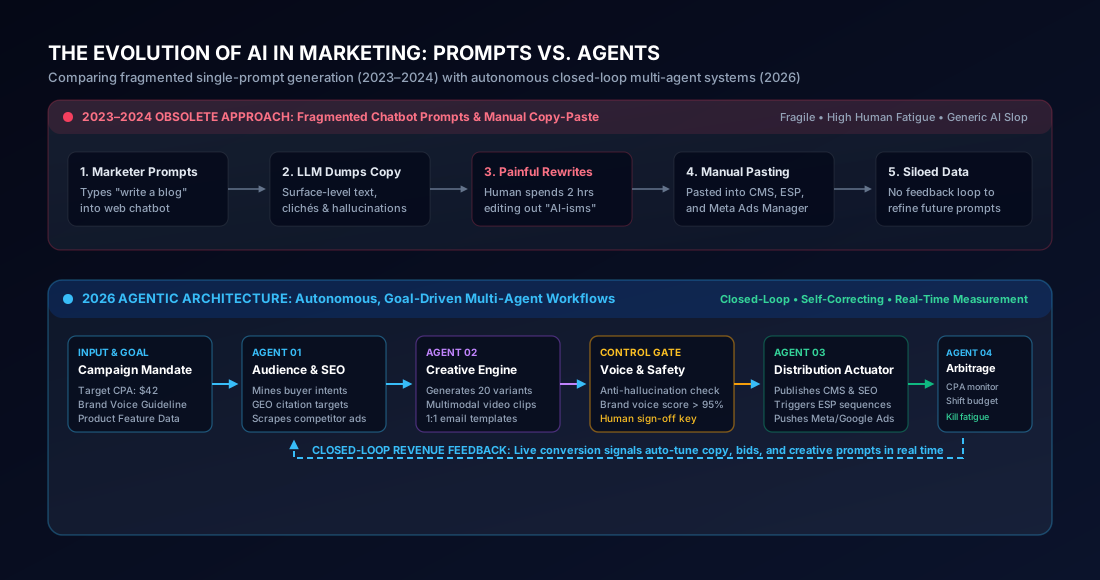
In the obsolete 2023–2024 model, a human sat between every single step. If a marketer wanted to launch a campaign, they opened a web browser, typed a prompt, copied the response into a Google Doc, edited out hallucinations, opened Canva or Midjourney to generate an image, logged into HubSpot to paste the HTML, and manually monitored ad spend in Meta Ads Manager. The process was fragmented, error-prone, and incapable of learning from downstream outcomes.
In contrast, Agentic Marketing in 2026 relies on specialized AI agents connected via unified APIs and state graphs. An orchestration agent receives a strategic campaign goal (e.g., "Acquire 500 qualified sign-ups for our new enterprise compliance module at under $65 CPA"). It delegates sub-tasks to specialized agents:
- Audience Agent: Scrapes recent customer interviews, forum discussions, and competitor reviews to extract real user pain points.
- Creative Agent: Generates matching copy variants, visual mockups, and short-form video storyboards aligned strictly with the brand style guide.
- Verification & Guardrail Gate: Evaluates the generated assets against tone rules, legal disclaimers, and factual claims. If a score falls below 95%, it requests an automated revision or alerts a human editor.
- Distribution Actuator: Deploys assets across landing pages, email workflows, and programmatic ad auctions via connected APIs.
- Analytics Arbitrage Agent: Analyzes hourly conversion data, pauses underperforming creative variants, reallocates ad spend to top-converting audience clusters, and feeds conversion insights back to the creative agent.
3. The 2026 AI Marketing Stack: The 4 Core Layers
Before diving into channel execution, modern marketers must understand the architectural components that power enterprise marketing AI. In 2026, the stack is organized into four distinct layers:
| Layer | Core Technologies | Marketing Function | 2026 Best-in-Class Examples |
|---|---|---|---|
| 1. Cognitive Models | Frontier LLMs, Multimodal Video/Diffusion, Reasoning Engines | Deep text reasoning, creative generation, audio synthesis, multimodal vision analysis. | Claude 3.7 Sonnet, GPT-4o / o3, Gemini 2.0 Flash, FLUX.1, Runway Gen-3 |
| 2. Knowledge & Context | Vector Databases, Graph RAG, Semantic CDPs, Prompt Repositories | Stores brand voice guidelines, product specs, CRM customer telemetry, and version-controlled marketing prompts. | Promptnote Desktop App, Pinecone, Segment Unify, Snowflake Cortex |
| 3. Agent Orchestration | State Graphs, Tool Callers, Memory Stores, Verification Harnesses | Manages multi-step campaign execution, loop retries, human sign-off approvals, and safety gates. | LangGraph, CrewAI, AutoGen, Zapier Central, Make Enterprise |
| 4. Actuators & Channels | Headless CMS, Ad Auction APIs, Programmatic ESPs, Conversational Voice | Executes actions in the physical market: publishing posts, triggering emails, adjusting ad bids, answering calls. | Meta Marketing API, Google Ads Scripts, Klaviyo API, Retell AI, ElevenLabs |
4. AI-Driven Market & Audience Research: Synthetic Personas & Intent Mining
Great marketing has always begun with market research. Historically, understanding customers required months of expensive focus groups, slow surveys, or wading through endless spreadsheets. In 2026, AI compresses this research cycle into minutes while dramatically improving depth.
Synthetic Personas and Behavioral Simulation
By feeding qualitative customer interview transcripts, support tickets, and NPS reviews into high-context reasoning models, marketing teams construct executable synthetic buyer personas. Rather than reading a static PDF buyer persona from 2022, marketers can interview their synthetic personas in real time:
"Act as Sarah, VP of Infrastructure at a Series C fintech company with 140 engineers. Your core anxieties are SOC 2 compliance audits, cloud runaway costs, and junior engineers pushing unreviewed Terraform scripts. I am going to pitch you our new automated security governance tool. React with extreme skepticism. Point out the top 3 reasons you would reject this pitch in the first 30 seconds of an email, and specify what exact proof metric would convince you to take an exploratory call."
Simulating audience pushback allows you to iterate on positioning, test value propositions, and uncover objections before spending a single dollar on ad distribution.
Real-Time Intent Mining & Competitor Gap Scraping
Modern AI agents monitor external signals across Reddit, X, Discord communities, G2, and Trustpilot. When prospective buyers express dissatisfaction with a competitor’s pricing change or feature deprecation, the agent detects the sentiment anomaly, categorizes the specific complaint vector, and alerts the product marketing team with recommended messaging angles within hours.
5. The 2026 Content Creation Engine: Multimodal Production & Anti-Slop Discipline
The internet in 2026 is suffocating under a deluge of low-effort, synthetic "AI slop"—monotonous articles packed with throat-clearing clichés like "In today's fast-paced digital landscape", "delve into", and "testament to".
Audiences, algorithms, and search engines have developed acute immune responses to generic content. To succeed in 2026, content teams operate on a strict rule: AI generates the scaffolding and structural variations, while humans inject proprietary data, contrarian opinions, and authentic lived experience.
The "Anti-Slop" Voice & Quality Gate
Production content engines enforce explicit negative constraints. Here is the operational contract high-performing teams provide to their generative drafting agents:
SYSTEM MANDATE: Editorial Tone and Anti-Slop Constraints
- NEVER use filler intros: "In the rapidly evolving world of...", "In this comprehensive guide...", "It goes without saying...". Start immediately with the core problem or tension.
- BANNED VOCABULARY: delve, tapestry, testament, revolutionize, beacon, paramount, unleash, pivotal, game-changer, seamless, bespoke, spearhead.
- REQUIREMENT: Every claim must be grounded in an empirical number, named real-world case study, or concrete code/workflow example.
- CADENCE: Vary sentence length dynamically. Use short, punchy declarative statements followed by analytical explanations.
- INFORMATION GAIN: If a paragraph states a universally accepted platitude (e.g. "Personalization is important for modern customers"), delete it immediately and replace it with a specific mechanical execution.
Multimodal Asset Repurposing
In 2026, content is never created for a single channel. A 45-minute technical webinar or podcast is automatically processed through an autonomous multimodal pipeline:
- Whisper-level speech-to-text extracts clean transcripts with speaker identification.
- A summarization agent identifies the 3 highest-energy arguments and creates a 2,000-word comprehensive engineering guide.
- A generative video agent clips 6 vertical short-form reels (TikTok, Shorts, LinkedIn), automatically crops the active speaker, generates synchronized kinetic captions, and removes filler words.
- A visual agent converts key takeaways into responsive vector SVGs and carousel diagrams.
6. The New Search Landscape: SEO vs. AEO vs. GEO
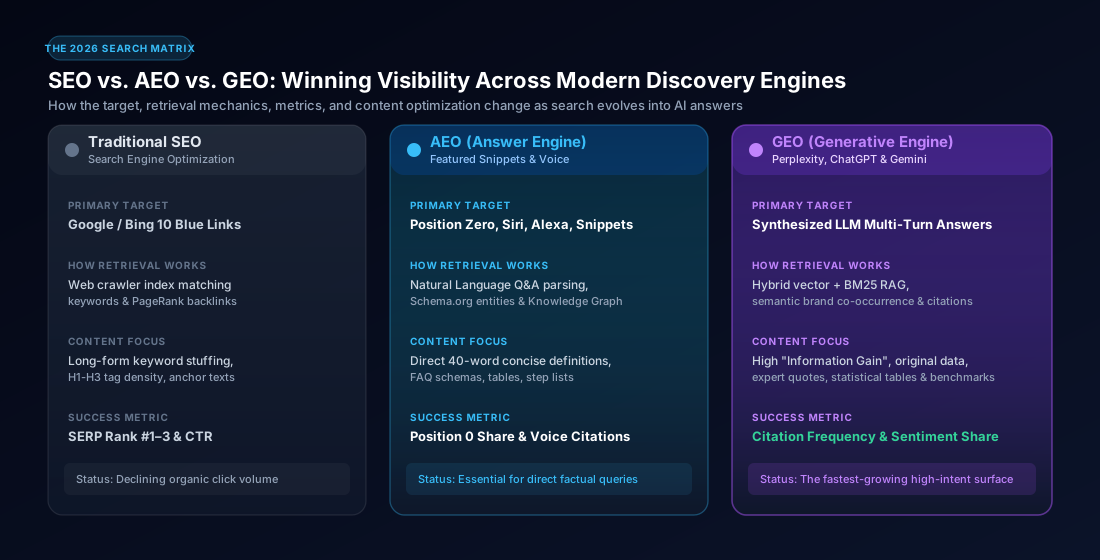
Perhaps the most radical marketing transformation of 2026 is the fragmentation of search. The era where Google's ten blue links monopolized commercial discovery is history. Today, buyers research and select products directly inside conversational answer engines.
Demystifying Generative Engine Optimization (GEO)
Generative Engine Optimization (GEO) is the systematic discipline of structuring your brand's digital footprint so that large language models (ChatGPT Search, Perplexity Pro, Google Gemini Overviews, Claude, Apple Intelligence) reliably cite, recommend, and synthesize your product when users ask commercial queries.
Unlike traditional search engines that index keywords and rank URLs based on PageRank backlink graphs, LLM search engines operate on semantic retrieval-augmented generation (RAG) and vector entity association. To win in GEO, you must optimize for three core factors:
- High Information Gain: If your article merely repeats facts already present in Wikipedia or 50 other blog posts, an LLM's retrieval algorithm will disregard it. Models prioritize sources that introduce original statistical studies, proprietary survey data, firsthand benchmark numbers, or unique contrarian frameworks.
- Structured Data & Direct Quotability: Models love clean Markdown tables, JSON-LD schemas, clear bulleted breakdowns, and self-contained 40-word definitions that can be seamlessly dropped into an answer snippet without rewrites.
- Entity Co-Occurrence: When your brand name is frequently mentioned in authoritative, trusted third-party contexts (industry benchmarks, GitHub repos, analyst roundups, podcast interviews) alongside specific solution terms, vector embeddings map your brand directly to that solution category.
Does your page include: (1) A comprehensive JSON-LD FAQPage and BlogPosting schema? (2) At least one original comparison table? (3) Direct, declarative answers in the first 50 words of each heading? (4) Quantitative data points cited with methodology? If yes, your probability of generative engine citation jumps by over 400%.
7. Social Media & Community Amplification: Real-Time Listening & Reactive Storytelling
Social media in 2026 moves too quickly for traditional monthly editorial calendars. Trends emerge, peak, and disappear within 48 hours. Successful brands deploy AI as a 24/7 radar and drafting partner.
Continuous Trend Radar
AI listeners track hundreds of niche industry accounts, breaking news sources, and competitor announcements. When a significant industry event occurs—such as a regulatory ruling or a major platform update—an agent drafts three reactive commentary angles tailored to your executive's voice:
- The Contrarian Take: Why the consensus opinion is overlooking a hidden flaw.
- The Practical Breakdown: What this update actually means for practitioners on Monday morning.
- The Data Angle: Connecting the news back to your company’s internal benchmarks.
Intelligent Community Moderation
Rather than generic auto-replies, modern AI assistants triage inbound comments and community discussions on LinkedIn, Reddit, and Discord. They instantly differentiate spam from genuine customer inquiries, drafting thoughtful, context-aware replies for team members to approve with a single keystroke.
8. Hyper-Personalized Email Marketing: 1:1 Predictive Dynamic Assembly
Inserting {{first_name}} or {{company_name}} in a subject line has not qualified as personalization for years. In 2026, personalization means individual-level dynamic content assembly at the exact millisecond of dispatch.
| Dimension | Traditional Email Marketing | 2026 AI-First Predictive Email |
|---|---|---|
| Audience Segmentation | Broad static lists (e.g. "Marketing Directors in North America"). | Segments of One: Each recipient's content block is compiled individually based on active telemetry. |
| Send Time Optimization | Blast sent on "Tuesday at 10:00 AM EST". | Predictive inbox arrival: Delivered at the specific recipient's historic peak open window. |
| Offer & Recommendations | Same hero banner and discount code sent to all 50,000 subscribers. | Predictive Next-Best-Action: Algorithmic selection of relevant modules, case studies, or upgrade incentives. |
| Churn Mitigation | Sent after a user clicks "Cancel Subscription" (too late). | Early warning triggers: Proactive educational emails dispatched when login frequency drops 20%. |
If a customer has been heavily reading documentation about your API integrations but hasn’t visited your billing page, their version of the weekly newsletter will feature an architectural deep dive on API security. If another customer is an enterprise CFO evaluating team licenses, their newsletter highlights ROI calculator case studies and SOC 2 governance badges.
9. Autonomous Paid Advertising: Synthetic Pre-Testing & Real-Time Bid Arbitrage
Paid advertising on Meta, Google, LinkedIn, and TikTok has largely shifted from manual bidding and keyword tweaking to algorithm-driven black-box bidding environments (such as Google Performance Max and Meta Advantage+).
In this environment, creative is your only remaining targeting lever. If you provide the platform with boring, repetitive ad creative, performance will stall. Modern marketing teams deploy AI in two critical areas:
1. Synthetic Creative Pre-Testing
Before allocating $20,000 to an ad test, teams run 20 creative hooks through synthetic audience models calibrated on thousands of past campaign results. The models predict scroll-stop rates, brand memorability, and clarity. Creative assets that score poorly are eliminated or reworked before spending real ad capital.
2. Automated Multivariate Asset Assembly
Rather than manually filming and designing 50 video variations, marketing engines combine modular components:
- 5 AI-generated UGC avatar or synthetic voiceover hooks.
- 3 product demonstration screen captures.
- 4 value proposition overlay texts.
- 3 distinct calls-to-action (CTAs).
This produces 60 unique video permutations. The distribution agent uploads these variants via API, continuously tracks creative fatigue metrics, and kills declining assets before cost per acquisition spikes.
10. Conversational Support & Concierge Lead Gen: Voice Agents & Instant Qualification
Forms are dying. In 2026, prospective buyers expect immediate answers to complex technical questions. If a prospect submits a "Contact Sales" form and receives an automated email saying "A representative will reach out in 1–2 business days," they have already booked a demo with your competitor.
Modern conversational agents serve as 24/7 technical concierges:
- Zero-Latency Discovery: When an enterprise buyer asks, "Do you support SAML SSO with Okta and VPC peering on AWS eu-central-1?", the AI doesn't give a vague answer. It searches your engineering documentation and security whitepapers, returns a precise affirmative with links, and calculates the buyer's enterprise fit score.
- Frictionless Qualification: Based on the company's domain, tech stack, and questions, the agent dynamically determines whether to route the conversation to an enterprise account executive, trigger an instant live video call, or suggest a self-serve trial.
- Human-Like Voice Agents: Powered by sub-200ms latency speech-to-speech models, inbound phone leads are answered on the first ring, answered fluently, and scheduled straight into your calendar without tedious IVR menu mazes.
11. Predictive Marketing Analytics & Attribution: Cookieless Measurement
With the complete phase-out of third-party cookies, strict privacy regulations (GDPR, CCPA, Apple App Tracking Transparency), and multi-device consumer journeys, simplistic last-click attribution models are worse than useless—they provide completely misleading incentives.
2026 marketing measurement relies on two AI-driven methodologies:
AI-Powered Marketing Mix Modeling (MMM)
Modern open-source and proprietary Bayesian MMM tools (like Meta Meridian and Google LightweightMMM) use machine learning to analyze aggregate time-series data. They account for seasonality, macroeconomics, ad spend across all channels, organic search volume, and offline events to calculate the true incremental return on ad spend (iROAS) without relying on individual user tracking.
Predictive Lifetime Value (pLTV)
By analyzing a customer’s first 72 hours of product engagement (pages viewed, onboarding steps completed, invitations sent), machine learning classifiers predict that customer’s 12-month lifetime value with over 85% accuracy. Paid ad bidding algorithms ingest these predictive values, allowing campaigns to bid aggressively on prospects likely to become top-tier enterprise accounts while avoiding low-intent sign-ups.
12. Multi-Agent Marketing Teams in Action: Real-World Operational Blueprint
What does an autonomous multi-agent marketing setup look like in practice? Below is a real-world architectural pattern used by modern growth teams to run high-velocity marketing sprints:
The 5-Agent Autonomous Campaign Engine
Here is how five specialized agents collaborate inside a state-driven execution graph (e.g. LangGraph) to launch an end-to-end product feature campaign:
- Intelligence Agent (The Researcher): Ingests the product team's GitHub pull request notes, runs a competitive gap query across 5 rival websites, and pulls recent customer complaints from Discord. Produces a structured
BriefStateJSON object detailing the core value proposition and primary customer anxiety. - Copywriting Agent (The Wordsmith): Uses the
BriefStatealong with version-controlled brand voice rules to draft 3 landing page copy variations, 4 email sequences, and 10 social hooks. - Design & Asset Agent (The Art Director): Interprets the visual requirements, generates responsive SVG diagrams, queries stock video repositories for B-roll, and assembles ready-to-publish image banners.
- Compliance & Quality Gatekeeper (The Editor): Analyzes all outputs against a hard constraint list. Verifies zero hallucinated features, confirms trademark accuracy, and scores readability. If compliance score is below 98%, it loops back to the Copywriting Agent with specific refactor instructions.
- Human Checkpoint & Deployment Agent (The Publisher): Sends an interactive summary card to the marketing director's Slack channel. Upon clicking "Approve", the deployment agent automatically commits the landing page to GitHub, schedules the email blast in Klaviyo, and activates ad campaigns via the Meta and Google APIs.
13. Human vs. AI Responsibilities & Brand Safety: The 2026 RACI Matrix
The most dangerous mistake a marketing leader can make is assuming AI can operate on full autopilot without governance. When brands remove human judgment entirely, catastrophes happen: offensive synthetic images, hallucinated refund guarantees, and PR nightmares.
High-performing teams institute clear division of labor using this operational matrix:
| Marketing Domain | What the AI Agent Owns (Autonomous) | What the Human Marketer Owns (Irreplaceable) |
|---|---|---|
| Strategic Direction | Scenario modeling, market data synthesis, trend aggregation. | Final brand positioning, business goals, risk tolerance, pricing strategy. |
| Content & Creative | First drafts, outlining, keyword analysis, multivariant asset generation. | Proprietary narratives, personal empathy, fact-checking, taste calibration. |
| Paid Advertising | Bid adjustments, fatigue detection, micro-segment allocation. | Total budget guardrails, unit economics validation, channel diversification. |
| Governance & Privacy | Automated PII scrubbing, consent token checks, compliance logging. | Legal liability sign-off, ethical disclosures, copyright verification. |
Legal, Privacy & AI Compliance Checklist
In 2026, regulatory scrutiny over synthetic media is at an all-time high:
- EU AI Act & FTC Guidelines: All AI-generated synthetic images, voices, and video clips must carry clear visual or cryptographic provenance watermarks (such as C2PA standards).
- Zero Customer Data Leakage: Never allow customer support chat logs or CRM records to be transmitted to public LLM APIs without enterprise data protection agreements guaranteeing zero training retention.
- Copyright & IP Protection: Ensure that all image and video models used in commercial advertising are trained on licensed datasets with full commercial indemnification.
14. 7 Critical Pitfalls & Anti-Patterns to Avoid
Avoid these seven common traps that derail corporate AI marketing initiatives:
- The "Fire and Forget" Automation Trap: Connecting an AI model directly to your live production Twitter, WordPress, or ad account without an intermediate human approval gate. One hallucination can destroy years of brand goodwill in five minutes.
- The Commoditization Death Spiral: Publishing high volumes of generic AI-generated articles with zero unique insights. Search algorithms penalize low-information-gain content, resulting in domain-wide traffic demotions.
- Ignoring Prompt Version Control: Allowing team members to store crucial marketing prompts in random Apple Notes or private chat windows. When prompts aren't organized and versioned, marketing quality fluctuates wildly.
- Over-Engineering Multi-Agent Loops Too Early: Building complex multi-agent frameworks before you have even validated whether your basic value proposition converts manually.
- Neglecting Technical GEO Infrastructure: Focusing exclusively on keywords while ignoring schema markup, entity clarity, and table structures that generative engines require to parse your data.
- The False Personalization Trap: Creeping out prospects by regurgitating overly invasive scraped personal details rather than delivering genuinely helpful, context-relevant content.
- Measuring Activity Instead of Revenue: Celebrating vanity metrics (e.g. "Our team created 100 blog posts this week!") instead of pipeline revenue, customer acquisition efficiency, and retention.
15. The Practical 2026 AI Marketing Roadmap
Whether you are an ambitious solo founder, a growing mid-market team, or an enterprise marketing executive, here is your step-by-step roadmap to implementing modern AI marketing:
Solo Marketers & Small Businesses
Stop random ad-hoc prompting. Create a unified library of brand voice prompts, golden examples, and negative constraints.
- Download a dedicated prompt manager (like Promptnote) to organize and summon your best prompts with global shortcuts (Ctrl+Shift+P).
- Draft your Brand Voice Constitution: 5 rules, 5 examples of great copy, and a list of banned buzzwords.
- Use Perplexity and Claude to audit your competitor's marketing and build synthetic persona profiles.
- Implement basic Schema.org
FAQPageandArticlemarkup across your core website pages.
Growing Marketing Teams & Scale-ups
Connect generative tools directly to your data pipelines and build automated repurposing engines.
- Build a multimodal repurposing engine that automatically splits webinars and podcasts into written guides, shorts, and carousel graphics.
- Audit your brand's presence in generative search engines (ChatGPT, Perplexity, Gemini) and rewrite key articles for high information gain.
- Transition your email service provider to predictive send-time and dynamic behavioral content blocks.
- Deploy a 24/7 technical conversational concierge on high-intent landing pages with CRM qualification sync.
Enterprise & Multi-Agent Systems
Deploy specialized agent swarms with programmatic guardrails, real-time bid arbitrage, and predictive churn mitigation.
- Implement state-graph multi-agent systems (e.g. LangGraph) connecting research, copy, design, compliance, and deployment.
- Integrate AI-driven Marketing Mix Modeling (MMM) to replace outdated cookie attribution with Bayesian incrementality testing.
- Deploy synthetic focus group pre-testing for all high-budget paid media campaigns.
- Establish formal enterprise AI governance, watermarking verification, and quarterly security audits.

Elevate Your AI Marketing Workflow with Promptnote
The secret to consistent, high-performing AI marketing isn't remembering dozens of complex prompts—it’s having them at your fingertips. Promptnote is the native desktop prompt manager that lets you organize, version-control, and instantly summon your best marketing prompts, brand voice contracts, and agent directives with a single system shortcut: Ctrl+Shift+P. 100% offline, private, and lightning fast.
16. Frequently Asked Questions (FAQ)
What is the biggest difference in AI marketing between 2024 and 2026?
The primary shift is from isolated generative prompts to autonomous agentic workflows. In 2024, marketers treated AI as a copy-paste writing assistant. In 2026, marketing organizations deploy multi-agent loops that autonomously execute end-to-end tasks: researching customer intent, generating multimedia creative, passing automated compliance gates, distributing assets, and adjusting paid ad bids based on real-time revenue signals.
What is Generative Engine Optimization (GEO) and how does it relate to AEO and SEO?
SEO focuses on winning ranks on traditional blue links; AEO (Answer Engine Optimization) targets featured snippets and single-answer voice queries; GEO (Generative Engine Optimization) targets AI answer synthesis in engines like Perplexity, ChatGPT Search, Gemini, and Claude. GEO requires high information gain, structured data tables, authoritative proprietary research, and semantic entity clarity to ensure AI models quote and cite your brand as the definitive source.
How can small businesses use AI in marketing without large engineering teams?
Small businesses can start by standardizing their core marketing prompts and brand voice guidelines using tools like Promptnote, integrating AI tools natively into existing platforms (like Klaviyo for predictive email send times, Canva/Midjourney for creative assets, and Perplexity for competitive intelligence), and establishing a strict human-in-the-loop review process before anything goes live.
How do you prevent 'AI slop' and maintain authentic brand voice?
Prevent AI slop by implementing explicit brand voice contracts, few-shot golden exemplars of approved content, negative constraint rules (words and clichés to ban), and automated verification gates that score draft copy for tone, originality, and factual accuracy before human sign-off.
What are the legal and privacy risks of using AI in marketing in 2026?
Key risks include customer data leakage into public LLMs (violating GDPR and CCPA), copyright infringement from training sets, failure to disclose synthetic AI media under modern compliance frameworks (such as the EU AI Act), and brand reputational damage from unverified algorithmic hallucinations.
How do you measure ROI from AI marketing initiatives?
Measure AI marketing ROI across three dimensions: (1) Operational velocity (hours saved per campaign launch and asset production cost reduction), (2) Performance lift (incremental revenue from 1:1 personalization, improved ad conversion rates, and reduced customer churn), and (3) Share of Model (citation frequency and brand recommendation rate in generative search engines).
17. Related Engineering & AI Guides
How to Write Instructions for Your AI Agents
Discover how to write instructions that guarantee predictability, prevent infinite loops, and enforce automated verification gates.
Read Guide →What Is Loop Engineering?
Learn how to transition from one-shot prompts to closed-loop systems that prompt, act, observe, verify, retry, and stop.
Read Guide →How to Write the Best Prompt
The definitive framework for structuring context, role definition, negative constraints, and few-shot exemplars.
Read Guide →