Introduction
Software development is changing quickly. The most obvious shift is that AI tools are now embedded in everyday workflows: drafting code, summarizing existing systems, automating tests, and helping teams accelerate research.
But this is not simply a story about automation replacing developers. It is a story about how engineers spend their attention. The best teams are using AI to reduce boilerplate, move faster through exploration, and focus more on judgment, systems thinking, and product outcomes.
What is changing in practice?
One immediate change is in how software gets built. Instead of starting from a blank page, many developers begin with a rough scaffold, a prompt, or a generated code draft. That speeds up onboarding and lowers the friction of experimentation.
- AI can generate first-pass code for simple features or internal tools.
- Developers can ask for explanations of unfamiliar code paths or dependencies.
- Teams can synthesize documentation faster and reduce knowledge silos.
- QA workflows can be accelerated with test generation and bug triage suggestions.
From code generation to engineering leverage
Generative AI is most valuable when paired with strong engineering habits. It does not replace system design, debugging instincts, or product reasoning. It amplifies them.
AI is best used as a force multiplier for engineers who already know what good architecture and user experience look like.
That means the highest-value developers are the ones who can ask better questions, review generated output critically, and integrate AI into real product workflows without sacrificing quality.
Benefits for product teams
For product teams, AI is reducing the time between idea and prototype. teams can explore more than one direction, validate assumptions earlier, and move quickly from concept to implementation.
It also helps non-developers participate more meaningfully in technical conversations by translating ideas into rough prototypes, structured requirements, and implementation plans.
Challenges teams need to manage
There are real risks. AI-generated output can be confident without being correct. It may reflect patterns from existing code without understanding the specific business constraints of a system. It may also create unmaintainable code if left unchecked.
- Review and validation remain essential.
- Security and privacy concerns must be considered carefully.
- Generated code should not bypass architectural review.
- Teams still need clear ownership and testing standards.
What good AI adoption looks like
Strong adoption usually looks modest and disciplined: use AI for repetitive work, high-variance tasks, and early ideation, but keep human review in the loop. One healthy workflow is to use AI to draft an implementation outline, generate tests, and summarize edge cases before a developer begins the final implementation.
Conclusion
The future of software development is not AI replacing engineering. It is engineering becoming more AI-aware, more iterative, and more strategic. Teams that learn to use AI as a collaborator rather than as a shortcut will likely move faster, learn more, and build better products.
Related articles
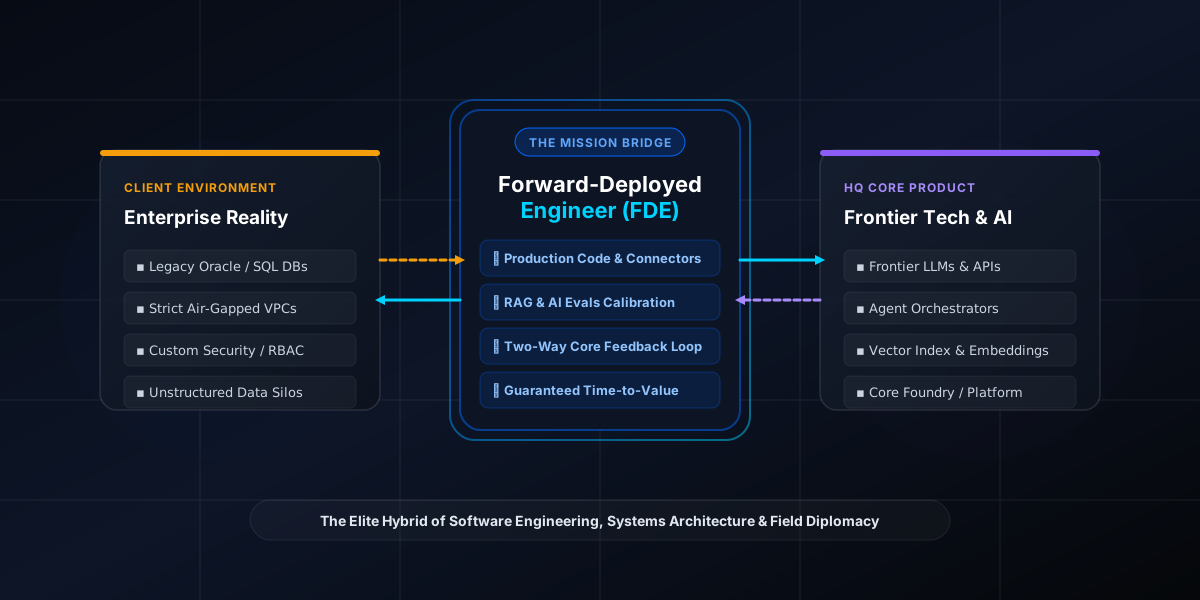
Forward-Deployed Engineer (FDE): The Definitive Guide