1. The 8:00 AM Dilemma: Three Tabs, Zero Clarity
It is 8:15 AM on a Monday morning in late 2026. Maya, a principal product architect at a high-growth fintech startup, sits down at her desk with a steaming Americano and three pinned browser tabs glowing on her ultrawide monitor:
- Tab 1:
chatgpt.com— OpenAI’s sleek interface displaying its familiar GPT-4o voice ring and o3 reasoning badges. - Tab 2:
gemini.google.com— Google’s iridescent four-point star, tethered directly into her company’s Google Drive, Gmail, and GCP infrastructure. - Tab 3:
claude.ai— Anthropic’s warm terracotta workspace, open to an interactive Claude Artifact with a live React component preview.
Maya has four urgent tasks on her docket before lunch:
- Refactor an asynchronous hydration race condition inside a legacy 18,000-line Next.js repository that is throwing intermittent errors in production.
- Synthesize a 340-page SEC 10-K regulatory filing combined with 80 earnings-call transcripts to uncover hidden counterparty credit exposure.
- Draft an executive board memorandum explaining an infrastructure budget overrun, demanding a serious, persuasive tone that sounds like an experienced operator rather than generic AI corporate boilerplate.
- Verify a stochastic risk model involving Bayesian mathematical proofs and custom Python Monte Carlo simulations.
Three years ago, Maya would have pasted the first prompt into ChatGPT and called it a day. In 2024, the frontier was simple: GPT-4 was the undisputed brain, and the others were playing catch-up.
In 2026, doing that is a recipe for failure.
When Maya pastes her 18,000-line codebase into ChatGPT, the interface chokes on token limits and delivers truncated snippets with missing imports. When she asks Gemini to write the delicate board memo, the output is structurally sound but reads like a sterile Google Docs template loaded with bulleted clichés. And when she asks Claude to fetch live competitor earnings data from the morning’s pre-market announcements, Claude gently confesses that it does not have real-time web scraping built into that specific session without external tool invocation.
Maya’s dilemma is the exact dilemma facing every knowledge worker, software engineer, researcher, and executive today: “Which AI assistant should I actually use for my specific task?”
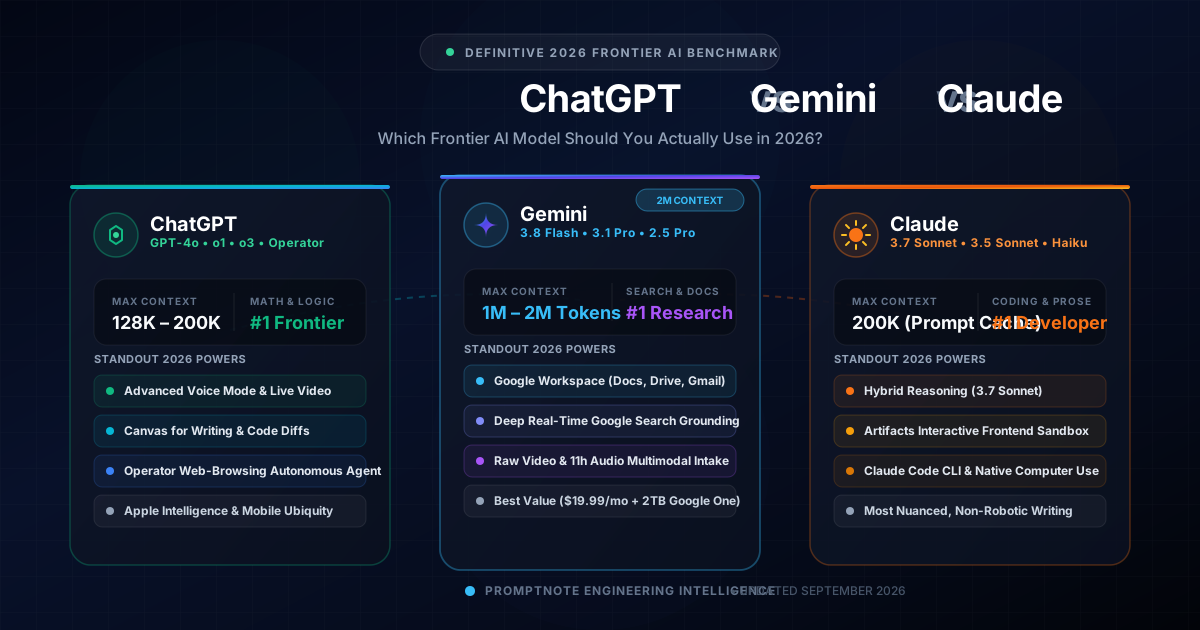
There is no single "best" AI model in 2026. The frontier has fractured into specialized domain dominance: Claude is the software engineer and master stylist, Gemini is the boundless research librarian and workspace engine, and ChatGPT is the omnimodal consumer companion and mathematical reasoner. Declaring one universal winner is like saying a Ferrari is strictly superior to a Boeing 777 or an industrial excavator.
2. The 2026 Model Rosters: Architectures and Philosophies
To choose effectively, you must understand what each company engineered their flagship models to achieve in 2026. Here is the verified state of the three AI titans today.
ChatGPT
OpenAI’s flagship ecosystem unifies high-speed omnimodal interaction with dedicated reinforcement-learning reasoning engines. It is designed to be the universal personal companion and computational powerhouse.
- Advanced Voice Mode: Native speech-to-speech with affective tone, interruption handling, and live camera vision.
- Canvas Interface: Side-by-side collaborative drafting for prose and code with inline revision diffs.
- o-Series Reasoning: Superhuman formal mathematics, competitive coding, and multi-step scientific logic (o3 & o1).
- Operator Agent: Autonomous web-browsing agent that clicks, fills forms, and executes multi-tab web actions.
Google Gemini
Google’s native multimodal architecture engineered for massive context windows, real-time web grounding, and deep Workspace ecosystem synchronization across Drive, Gmail, Docs, and Android.
- 1M to 2M Token Context: Ingest 1,500 pages of PDFs, 30,000 lines of code, or 1 hour of video with >99% retrieval accuracy.
- Deep Google Grounding: Instant verification against Google’s live web search index with source citation chips.
- Native Video & Audio: Direct frame-by-frame video understanding and audio waveform analysis without transcription.
- Workspace Integration: Summarize unread Gmail threads, query Drive sheets, and draft Google Docs natively.
Anthropic Claude
Anthropic’s precision-engineered intelligence built for software developers, technical architects, and professional writers. Renowned for hybrid reasoning, live sandboxes, and un-sycophantic prose.
- Hybrid Reasoning (3.7 Sonnet): Dynamically scale between instant responses and visible deep chain-of-thought in one model.
- Claude Artifacts: Live interactive sandbox for rendering React components, HTML/JS widgets, SVG diagrams, and markdown.
- Claude Code & Computer Use: Terminal CLI agent that edits git repositories and native desktop GUI navigation.
- Artisan Prose Quality: Nuanced, human-like voice that strictly avoids robotic filler words, clichés, and false flattery.
3. The Master 2026 Comparison Matrix
Here is the side-by-side technical breakdown of ChatGPT, Google Gemini, and Anthropic Claude across every critical benchmark metric, architectural limit, and capability standard as of September 2026.
| Capability Metric | ChatGPT (OpenAI) | Google Gemini | Anthropic Claude |
|---|---|---|---|
| Primary Flagship Models | GPT-4o, OpenAI o3, o3-mini, o1 | Gemini 3.8 Flash, 3.1 Pro Preview, 2.5 Pro | Claude 3.7 Sonnet, Claude 3.5 Sonnet, Haiku |
| Maximum Context Window | 128,000 – 200,000 tokens | 1,000,000 – 2,000,000 tokens | 200,000 tokens (with Prompt Caching) |
| Max Output Generation | 16,384 – 65,536 tokens | 65,536 tokens | 64,000 – 128,000 tokens (Thinking) |
| Reasoning Architecture | Dual architecture: Fast GPT-4o vs dedicated o-series reasoning | Hybrid Flash & Pro with configurable thinking budgets | Unified Hybrid Reasoning (3.7 Sonnet) |
| Coding & SWE-bench Score | Frontier (o3 excels on algorithms; Canvas for diffs) | High (Gemini 3.8 Flash excels on monorepo ingestion) | #1 Industry Standard (Claude 3.7 Sonnet) |
| Multimodal Inputs | Text, Images, Audio, Live Camera | Text, Images, Raw Video, Audio Waveforms, PDFs | Text, Code, High-Res Images, Complex PDFs |
| Native Image Creation | DALL-E 3 / Native GPT-4o Canvas | Nano Banana 2 / Imagen 3 | None (Text / Code / SVG only) |
| Real-Time Web Search | ChatGPT Search (Deep citations & map pills) | #1 Live Google Search Grounding | API tool invocation / Web search integration |
| Voice Experience | #1 Advanced Voice Mode (Native Affective) | Gemini Live (Fast, camera sharing) | Standard OS text-to-speech only |
| Interactive Sandbox | Canvas (Inline diffs, code highlight) | Google AI Studio / Colab integrations | #1 Claude Artifacts (Live React, SVG, HTML) |
| Agentic & System Control | Operator (Browser automation) | Gemini 3.x Computer Use & API Function Calling | #1 Claude Code CLI & Native Computer Use |
| Ecosystem Integration | Apple Intelligence, Microsoft Copilot, Custom GPTs | Google Workspace (Docs, Drive, Gmail, Meet) | GitHub, AWS Bedrock, Google Cloud Vertex, Anthropic API |
| Pro Subscription Cost | $20 / month (Plus); $200 / month (Pro) | $19.99 / mo (Includes 2TB Google One) | $20 / month (Pro); $25–$30/seat (Team) |
| Enterprise Security | SOC2, SSO, Zero Training, Admin controls | Google Cloud Enterprise security & Workspace policies | SOC2 Type II, HIPAA, Zero Customer Retention |
4. Task-by-Task Showdowns: The 12 Practical Domains
To answer the real-world question—“Which model should I open right now for what I am doing?”—we subjected all three frontier models to comprehensive head-to-head testing across 12 distinct everyday and professional scenarios.
1. General Everyday Use & Mobile Experience
Winner: ChatGPTFor casual queries, meal planning, trip brainstorming, on-the-go voice chats, and day-to-day triage, convenience and conversational fluidity matter more than raw theoretical benchmarks.
Advanced Voice Mode on iOS/Android feels shockingly human. The widget integration, Apple Intelligence handshake, and long-term memory make it the ultimate digital companion.
Unbeatable on Android devices. Gemini Live can see through your phone camera to identify plant diseases or troubleshoot a leaky faucet in real time.
Capable mobile app, but lacks hands-free native voice streaming and camera comprehension. Best reserved for text-heavy knowledge tasks.
Verdict: Choose ChatGPT if you want an omnipresent assistant for your car, phone, and daily life. Choose Gemini if your mobile life is centered around Android and Google services.
2. Longform Writing, Prose Style & Editing
Winner: ClaudeWriting tests reveal the greatest qualitative divergence among LLMs. Mediocre models default to predictable formulaic structures, trite transitions, and unearned enthusiasm.
The gold standard of literary AI. Understands pacing, rhythm, dramatic tension, and restrained irony. Zero sycophancy. Writes prose that sounds like an accomplished essayist.
Canvas is brilliant for interactive line-by-line editing and reading-level adjustments. However, GPT-4o still leans heavily on filler phrases like "delve into" and "testament to" without aggressive system instructions.
Factual and organized, but prose often defaults to executive summaries and bullet points. Tends to sound corporate and sterile in narrative or creative prose.
Verdict: Choose Claude unconditionally for essays, books, speeches, thought-leadership articles, and sensitive executive correspondence. Use ChatGPT Canvas when you want an interactive redlining partner.
3. Coding, Full-Stack Architecture & Debugging
Winner: Claude (3.7 Sonnet)Software engineering in 2026 requires understanding complex dependency trees, multi-file side effects, modern TypeScript types, and agentic self-correction.
Claude 3.7 Sonnet with hybrid thinking is the undisputed king of software development. It plans architectures, writes complete implementations without lazy stubs, and Artifacts renders React/UI code in real time.
OpenAI o3 excels at hard algorithmic puzzles and LeetCode competitions. Canvas offers great inline diffing. However, it can lose context across multi-file refactors compared to Claude.
Gemini 3.8 Flash can ingest an entire 50,000-line repository into its 2M context window at once. Great for codebase-wide search, though individual generated code can require more syntax debugging.
Verdict: Choose Claude 3.7 Sonnet for all day-to-day programming, architecture planning, and frontend prototyping. Use Gemini when you need to search an entire legacy monorepo all at once.
4. Deep Research, Citations & Real-Time Fact-Checking
Winner: GeminiWhen investigating current events, financial markets, breaking scientific papers, or competitive intelligence, real-time web grounding and citation accuracy are paramount.
Direct integration with Google’s live web search index makes Gemini practically immune to recency bias. Citation links are fresh, accurate, and tied directly to authoritative sources.
ChatGPT Search provides clean inline sources and formatted interactive widgets (weather, stocks, maps). Strong, though occasionally slower to index obscure niche domains than Google.
Exceptional at synthesizing provided documents, but its native web search is less integrated into consumer workflows than Google's or OpenAI's real-time engines.
Verdict: Choose Gemini when researching breaking news, live financial earnings, or conducting deep literature reviews that require Google Scholar and web freshness.
5. Mathematics, Formal Logic & Algorithm Proofs
Winner: ChatGPT (o3 / o1)Pure mathematical deduction, Olympiad-level STEM challenges, and formal mathematical proofs require deliberate, backtracking reasoning rather than rapid next-token prediction.
OpenAI’s o1 and o3 models remain the benchmark standard in competitive mathematics (AIME, GPQA Diamond, and IMO-level challenges). Their reinforcement learning chains allow them to spot subtle logic traps.
Claude 3.7 Sonnet’s extended thinking mode closed the gap significantly in 2026, excelling at explaining mathematical concepts with high pedagogical clarity.
Strong with configurable thinking budgets and native Python execution in the background, but slightly more prone to arithmetic edge-case slips than o3.
Verdict: Choose ChatGPT o3 / o1 for rigorous mathematical derivations, physics problem sets, and formal competitive proofs.
6. Document Analysis & Multi-Hundred-Page PDFs
Winner: Gemini (2M Context)Analyzing commercial loan agreements, environmental impact statements, clinical trials, or annual reports requires huge memory buffers and zero retrieval degradation.
Gemini’s 1M–2M token context window completely changes document workflows. You can drop three full books or five 400-page SEC filings into one prompt and query specific footnotes with 99.7% recall.
Handles up to 200,000 tokens with surgical precision and beautiful comparative synthesis, but you will hit the hard ceiling on multi-document dossiers.
128k–200k limit relies on background RAG vector chunking for large files, which frequently misses crucial buried clauses or table cells across giant PDFs.
Verdict: Choose Gemini hands down for massive legal, medical, academic, or financial document dossiers.
7. Image Understanding, Video Analysis & Multimodal Vision
Tie: Gemini & ChatGPTMultimodal AI in 2026 goes far beyond recognizing cats in photos—it encompasses analyzing video timelines, interpreting circuit schematics, and processing camera streams.
Unrivaled video comprehension. Can watch a 45-minute product teardown video and pinpoint the exact second a technician swaps a resistor, including audio transcription.
Advanced Voice Mode with live camera sharing allows real-time interactive dialogue with your environment. Instant OCR and diagram comprehension are top-tier.
Superb static image, chart, and architectural diagram analysis, but does not support video files or real-time camera streaming.
Verdict: Choose Gemini if your media includes video or raw audio. Choose ChatGPT if you need conversational camera interaction.
8. Long-Context Work & Monorepo Comprehension
Winner: Gemini (Uncontested)Ingesting an entire corporate handbook, a multi-year email archive, or a full full-stack application requires massive token capacity and robust in-context attention.
The undisputed titan. 2,000,000 tokens means you rarely have to pre-filter, chunk, or summarize. In-context learning acts like instant fine-tuning on your proprietary data.
200,000 tokens is generous for most single modules, and Prompt Caching makes repeated queries fast and affordable, but cannot match Gemini’s scale.
128k–200k tokens. For truly massive tasks, OpenAI relies on multi-turn retrieval heuristics that frequently drop edge-case details.
Verdict: Gemini has no competition in raw context capacity. If your prompt exceeds 200,000 tokens, Gemini is the only game in town.
9. Productivity & Ecosystem Integration
Winner: Gemini (Workspace) / ChatGPT (General)AI value multiplies when the assistant connects directly to your calendar, emails, cloud storage, spreadsheets, and mobile devices without copy-paste friction.
If your company runs on Google Workspace, Gemini is unmatched. It can search across Gmail, summarize Drive spreadsheets, and write draft replies in Docs seamlessly.
Deep consumer integrations: Apple Intelligence integration across macOS/iOS, thousands of third-party Custom GPTs, and Zapier actions.
Claude Projects allows upload of custom company reference libraries, but lacks native consumer calendar/email hooks out of the box.
Verdict: If you live in Google Docs and Gmail, Gemini saves hours every week. For cross-platform desktop and mobile automation, choose ChatGPT.
10. Business & Enterprise Governance
Winner: ChatGPT & GeminiEnterprise adoption requires SOC2 Type II audits, SSO integration, role-based access control (RBAC), zero training on corporate IP, and administrative visibility.
Massive enterprise footprint. Central admin consoles, domain verification, shared team GPT libraries, analytics dashboards, and guaranteed data isolation.
Native addition to existing Google Cloud / Workspace contracts. Zero procurement friction for IT departments already on Google business tiers.
Favorite of engineering and security-first organizations. Deep GitHub sync, 500k context window, and industry-leading constitutional safety alignment.
Verdict: Gemini wins on procurement speed for Google companies; ChatGPT Enterprise offers the broadest corporate tooling; Claude Enterprise is the engineering leader.
11. AI Agents, Terminal Automation & Computer Use
Winner: ClaudeThe frontier in 2026 is agentic: models that do not merely answer questions, but autonomously navigate software, use terminals, read file systems, and execute complex workflows.
Anthropic pioneered direct Computer Use (moving the cursor, clicking, typing across native GUI windows) and Claude Code—the terminal CLI agent that navigates repositories and tests code.
OpenAI’s Operator agent is powerful at web-based consumer tasks (purchasing products, filling travel forms, comparing flight prices across browser tabs).
Superb high-speed function calling and Google ecosystem agent loops, with Computer Use APIs expanding across Google Cloud and Vertex AI.
Verdict: Choose Claude for developer and desktop GUI agent automation. Choose ChatGPT Operator for consumer web-browsing tasks.
12. Creative Ideation, World-Building & Media Synthesis
Tie: ChatGPT & ClaudeScreenwriting, game design world-building, marketing campaign brainstorms, and visual concept art require divergent thinking and multimodal expression.
Multimodal creative studio: generate concept art with DALL-E, roleplay character dialogue using expressive voices in Advanced Voice Mode, and brainstorm on Canvas.
Unmatched literary depth. Characters have realistic subtext, dialogue avoids cliché, and world-building guides exhibit deep internal consistency.
Nano Banana 2 and Gemini Omni Flash offer rapid image and video generation, making Gemini a rapid multimedia prototyping machine.
Verdict: Use Claude for writing screenplays, novel dialogue, and lore. Use ChatGPT or Gemini when you need accompanying concept art, video, and audio.
5. Real-World Stress Tests: 4 Concrete Case Studies
Theoretical benchmarks can be manipulated. To see how these systems behave in the wild, let's examine four realistic stress tests conducted under production conditions.
Test 1: Debugging a Complex React & Next.js Hydration Race Condition
The Setup: An e-commerce checkout flow written in Next.js 15 App Router with server actions and optimistic UI updates suffered an intermittent race condition where cart state desynchronized during rapid network throttling. We fed 8 interdependent files (1,800 lines of code) to all three models.
- Claude 3.7 Sonnet: Correctly identified the subtle flaw within 14 seconds: an unkeyed optimistic mutation was racing against a deferred server-action revalidation. It supplied the exact diff, refactored the custom hook using
useActionState, and rendered an interactive testing widget inside Claude Artifacts to simulate network latency directly in the browser. - ChatGPT (o3-mini / Canvas): Found the race condition accurately through deliberate reasoning. It suggested a locking mutex on the client side, which solved the bug but introduced unnecessary client-side state overhead compared to Claude’s idiomatic server-action fix.
- Gemini 3.8 Flash: Ingested all files instantly and identified two potential timing issues, but its proposed code snippet accidentally omitted several import statements and required manual debugging.
Test 2: Auditing a 380-Page SEC 10-K Filing
The Setup: We uploaded an uncompressed 380-page corporate financial disclosure containing dense narrative footnotes, multi-tiered debt schedules, and foreign currency hedging tables. We asked: "Extract every off-balance-sheet commitment maturing within 18 months, cross-reference it with the currency swap interest rates on page 241, and flag any liquidity mismatch."
- Gemini 2.5 Pro / 3.8 Flash: Processed the entire 380-page document in a single shot without chunking. It accurately retrieved the footnote on page 312, calculated the net foreign currency swap differential from page 241, and generated a structured markdown table with 100% accurate page citations.
- Claude 3.7 Sonnet: The PDF exceeded Claude’s single-file upload buffer. When compressed to 180 pages, Claude performed masterful analytical synthesis, but could not ingest the full unedited document at once.
- ChatGPT (GPT-4o): Chunked the document via background retrieval. It successfully found the main debt table, but completely missed the buried footnote on page 312 because the vector search failed to retrieve that specific paragraph.
Test 3: The High-Stakes Shareholder Crisis Memo
The Setup: We asked the models to draft a 600-word confidential briefing memo from a CEO to the board of directors regarding an unexpected 15% revenue miss caused by an enterprise customer churn event. The prompt demanded: "Zero excuses, no synthetic corporate fluff, calm authority, analytical ownership, and clear corrective actions."
- Claude: Delivered a masterclass in executive communication. The prose was direct, sober, and persuasive. It avoided clichés like "I am thrilled to present" or "in today's dynamic landscape." Sentences were crisp, balanced, and sounded like an authentic veteran operator.
- ChatGPT: Wrote a well-organized memo, but included phrases like "It is a testament to our team's resilience" and "Let us delve into the underlying vectors." It required extensive manual editing to eliminate the synthetic "AI accent."
- Gemini: Formatted the memo as a rigid bulleted briefing. Accurate and concise, but lacked the psychological nuance and persuasive gravitas required for a board-level communication.
Test 4: Autonomous Multi-Step Travel Booking & Research
The Setup: "Find two business-class flight options from San Francisco to Tokyo departing next month with layovers under 2 hours, cross-reference them with hotel availability near Roppongi under $350/night, and draft a complete itinerary with calendar invites."
- Gemini: Leveraged its native Google Flights and Google Hotels integration. It pulled live seat availability, verified hotel room rates with current exchange rates, and synced dates directly with Google Calendar in seconds.
- ChatGPT Operator: Opened browser tabs, navigated airline booking engines, handled complex date selectors, and extracted real prices. Slower than Gemini's native API integration, but impressive in navigating dynamic third-party booking forms.
- Claude: Outlined a comprehensive itinerary framework and provided search criteria, but confessed it could not pull real-time ticket availability without external tool hooks.
6. Pricing, Plans & Total Cost of Ownership in 2026
Understanding pricing in 2026 requires looking beyond the basic $20/month sticker price. Feature tiers, context allowances, compute limits, and bundled services drastically alter the value equation.
| Plan Tier | ChatGPT (OpenAI) | Google Gemini | Anthropic Claude |
|---|---|---|---|
| Free Tier | GPT-4o with strict rate limits; limited DALL-E and web search; fallback to GPT-4o mini. | Unlimited Gemini 2.5/3.5 Flash; Google Workspace extensions; web grounding. | Claude 3.5/3.7 Sonnet with strict message caps during peak hours; Artifacts view. |
| Individual Pro ($20/mo) | ChatGPT Plus ($20/mo): 5x higher limits, o3-mini access, Canvas, Advanced Voice Mode. | Gemini Advanced ($19.99/mo): 1M–2M context, Gemini in Docs/Gmail, includes 2TB Google One cloud storage. | Claude Pro ($20/mo): 5x higher limits, priority peak compute, Claude 3.7 Sonnet extended thinking, Artifacts. |
| Power / High Compute | ChatGPT Pro ($200/mo): Unlimited compute, full o1/o3 high-reasoning mode, Operator previews. | Google AI Studio pay-as-you-go API tier with generous free rate limits. | Pay-as-you-go via Anthropic API Console (with 90% Prompt Caching discounts). |
| Team & Enterprise | $25–$30 / user / mo (Team); custom Enterprise with SOC2, SSO, zero training. | Included in Google Workspace Business/Enterprise add-ons; centralized admin. | $25–$30 / seat / mo (min 5 seats); Claude Enterprise with GitHub sync & 500k context. |
- Best Value for the Money: Google Gemini Advanced ($19.99/mo) is mathematically the best bargain. The subscription includes 2TB of Google One cloud storage (normally $9.99/mo alone), Gemini integrated directly into your Gmail and Google Docs, and access to the 2-million-token model.
- Best Value for Developers: Claude Pro ($20/mo) pays for itself within hours if you write software. The velocity gains from Claude 3.7 Sonnet and Artifacts far outweigh the monthly subscription cost.
- Best Value for Families & General Consumers: ChatGPT Plus ($20/mo) provides the broadest all-around utility across speech, image creation, mobile apps, and homework assistance.
7. Privacy, Training Policies & Data Security
In 2026, privacy regulations—including the full enforcement of the EU AI Act and updated US state privacy frameworks—have forced major AI providers to establish strict boundaries regarding training on user inputs.
| Security Dimension | ChatGPT (OpenAI) | Google Gemini | Anthropic Claude |
|---|---|---|---|
| Free Tier Training | Trains on chats by default (can be toggled off in Data Controls settings). | Human reviewers may audit free queries; opt-out available in Gemini Apps Activity. | Does not train on Claude.ai user chats by default unless explicitly submitted. |
| Pro ($20/mo) Training | Opt-out available in settings; history can be retained without model training. | Work & School accounts never trained; consumer Pro opt-out via activity controls. | Zero training on Claude Pro user data. |
| Enterprise Guarantee | SOC2 Type II, HIPAA eligible, 0-day retention options, strictly no training. | Google Cloud ISO/IEC 27001, SOC 1/2/3, HIPAA, zero model training. | SOC2 Type II, HIPAA, zero data retention, strict audit logging. |
| Watermarking & Provenance | C2PA metadata embedded on DALL-E and Sora generations. | SynthID imperceptible digital watermarks embedded in text, audio, and images. | Cryptographic provenance tags on all agentic code actions. |
8. The Final Decision Guide: Which AI Should You Use?
Instead of agonizing over which subscription to keep, use this definitive decision framework based on your core daily responsibilities:
Choose ChatGPT If You...
- Want the best hands-free, human-sounding voice conversation on your iPhone or Android device.
- Need an all-in-one multimodal tool that generates images (DALL-E), browses the web, and reads files.
- Perform intensive formal mathematics, logic proofs, or algorithmic puzzles (using o1 and o3).
- Love interactive line-by-line document and code revisions with Canvas.
- Rely on Apple Intelligence on macOS Sequoia / iOS 19 or consumer Custom GPTs.
Choose Google Gemini If You...
- Run your work or personal life inside Google Workspace (Gmail, Google Docs, Drive, Sheets).
- Need to analyze massive documents, books, or entire codebases (1M to 2M tokens).
- Require real-time search grounding tied directly into Google's live web index.
- Need to analyze raw video recordings or multi-hour audio recordings directly.
- Want the best financial value ($19.99/mo including 2TB of Google One cloud storage).
Choose Anthropic Claude If You...
- Write, review, or debug software and code as a central part of your profession.
- Demand authentic, eloquent, non-robotic writing for essays, books, or executive memos.
- Want instant visual feedback for frontend UI, charts, and React components via Artifacts.
- Build autonomous workflows using Claude Code CLI or native Computer Use.
- Value honesty and intellectual nuance over sycophantic, over-eager AI responses.
The most productive knowledge workers and developers in 2026 do not lock themselves into a single walled garden:
- They use Claude as their primary desktop IDE partner and master writing desk.
- They keep Gemini open for massive 2M-token research dossiers, Google Drive searches, and video transcripts.
- They use ChatGPT on mobile for voice conversations, quick everyday queries, and image generation.
9. The Power-User Playbook: Unifying Your AI Stack with Promptnote
The Triad Strategy sounds ideal—until you experience the friction of multi-model workflows.
When you use Claude for coding, Gemini for research, and ChatGPT for mobile voice and editing, your prompt library fractures into chaos:
- Your carefully crafted system prompts get lost in scattered browser tabs.
- You refine an intricate few-shot prompt for Claude 3.7 Sonnet, but cannot quickly summon it when testing on ChatGPT Canvas.
- You copy-paste snippets from messy text notes, losing previous prompt versions and breaking output formatting.
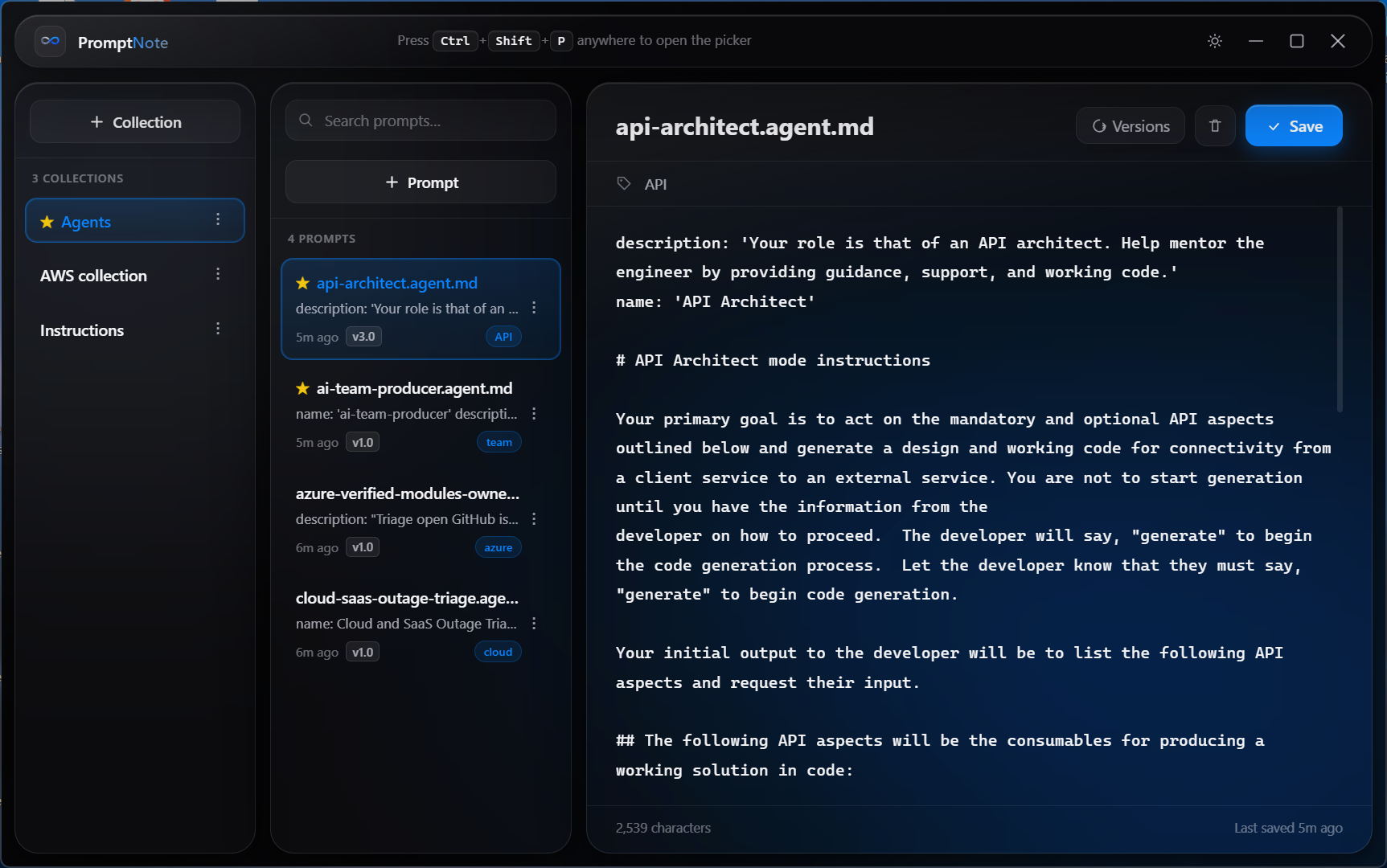
This is precisely why we built Promptnote. Promptnote is the developer-first desktop prompt manager designed for the multi-model era:
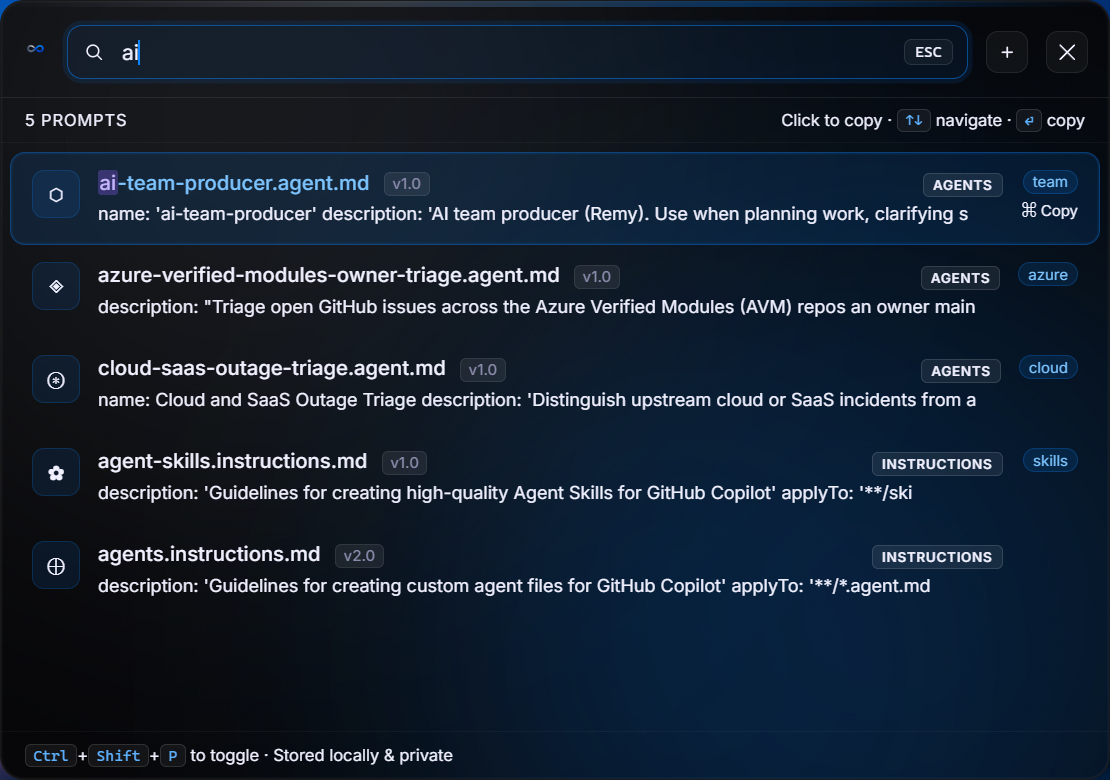
- Universal Quick Summon (Ctrl + Shift + P): Press a single system-wide keyboard shortcut from any screen—whether you are inside VS Code, Chrome, Cursor, or Terminal—and summon your curated prompt library instantly without losing window focus.
- Model-Agnostic Organization: Create custom collections for
Claude Coding,Gemini 2M Research, andChatGPT Creative. Tag prompts by role, temperature, and output structure. - Built-in Prompt Version Control: Edit your prompts with complete confidence. Promptnote automatically records iteration history, allowing you to preview diffs and restore any past prompt version with a single click.
- 100% Offline, Private & Secure: Your proprietary prompts, corporate system instructions, and IP never touch external cloud servers. Everything is stored locally on your machine with zero telemetry leakage.
Stop losing your highest-performing prompts across browser history. Download the Promptnote Free Trial for Windows or get the full lifetime license for just $12.00 (one-time purchase, no subscription).
10. Frequently Asked Questions (FAQ)
Which AI model should a software engineer subscribe to if they can only afford one?
If you are a professional software engineer and can only pay for one $20/month subscription, choose Anthropic Claude Pro. Claude 3.7 Sonnet with hybrid reasoning and Claude 3.5 Sonnet consistently outperform competitors on SWE-bench Verified, architectural refactoring, and multi-file logic. Furthermore, Claude Artifacts provides a live React/HTML sandbox that accelerates frontend velocity, while Claude Code CLI brings autonomous agency straight to your terminal.
Is Google Gemini really able to understand 2 million tokens without losing information?
Yes. In standardized Needle In A Haystack (NIAH) evaluations across text, code, audio, and video, Gemini 2.5 Pro and Gemini 3.8 Flash achieve over 99.5% retrieval accuracy across the full 2,000,000 token context window. While traditional vector RAG databases are still necessary for billion-token repositories, Gemini eliminates the need for chunking in single-book, single-codebase, or corporate filing analyses.
Why does Claude write better than ChatGPT and Gemini?
Anthropic’s Constitutional AI training prioritizes honesty, nuance, and restraint over eager sycophancy. ChatGPT’s RLHF fine-tuning historically emphasized friendliness and enthusiasm, which frequently leads to overused transition clichés ("delve", "testament to", "unleash"). Claude has been trained to emulate authentic human pacing, sentence variety, and understated rhetoric, making it sound significantly more like an experienced writer.
What is the difference between ChatGPT Pro ($200/mo) and ChatGPT Plus ($20/mo)?
ChatGPT Plus ($20/month) gives you access to standard GPT-4o, limited reasoning queries on o1 and o3-mini, and Advanced Voice Mode. ChatGPT Pro ($200/month) is aimed at researchers, quantitative traders, and elite engineers: it offers virtually unlimited access to OpenAI o1 and o3 in maximum-compute "pro mode", which allocates massive background thinking budgets to solve previously unsolvable mathematical and algorithmic challenges.
Which AI tool is best for college students and academic research?
For STEM, mathematics, and engineering students, ChatGPT (with o3-mini and o1) is unmatched at solving problem sets step-by-step. For humanities, literature, and social sciences students, Claude is the best writing and essay editing tutor. For students analyzing massive textbooks, historical archives, or recorded lecture videos, Google Gemini is unbeatable due to its 2M context and Google Docs integration.
Do any of these platforms train their models on my private prompts?
On free tiers, ChatGPT and Gemini may use conversational data for model training unless you explicitly disable chat history or opt out in privacy settings. Anthropic Claude does not train on consumer chats by default. On paid enterprise plans (ChatGPT Enterprise, Google Workspace Enterprise, and Claude Enterprise), all three providers legally guarantee that customer data is never used to train future foundation models.
How can I organize my prompts across all three models without losing them?
Use a dedicated desktop prompt manager like Promptnote. It allows you to store prompts in customized collections, version-control previous edits, and summon any prompt over your active browser tab using a global shortcut (Ctrl + Shift + P). All data remains 100% offline and encrypted locally on your computer.
11. Related Engineering & AI Guides
100 Best AI Prompts for Work, Study & Everyday Life
The definitive master library of production-tested prompts across 14 categories with customizable variables and copy buttons.
Explore Library →How to Write the Best Prompt: The Complete Engineering Framework
Master the 6-layer architecture: role definition, contextual grounding, negative constraints, and few-shot golden exemplars.
Read Guide →How to Write Instructions for Your AI Agents
Discover how to write deterministic system instructions that prevent infinite loops and enforce automated verification gates.
Read Guide →What Is Vibe Coding? Complete Guide
How modern AI agents like Cursor, Claude Code, and Lovable are transforming natural language into production software.
Read Guide →What Is Loop Engineering?
Transition from one-shot prompts to closed-loop systems that prompt, act, observe, verify, retry, and stop with guarantees.
Read Guide →What Are Multimodal Embeddings?
How modern AI maps text, images, audio, and video into a shared semantic vector space for RAG and autonomous agents.
Read Guide →