The Fortune 500 War Room: Why Pure Code Isn't Enough
It is 8:45 AM on a Monday inside the high-security headquarters of a top-tier global financial institution. A \$20 million enterprise contract for a next-generation generative AI intelligence platform hangs by a thread.
On paper, the software is revolutionary. In benchmark tests conducted in pristine cloud environments, the frontier language models parsed multi-page regulatory filings with 98% accuracy and synthesized quantitative risk reports in sub-second latency. But inside the client's actual production environment, disaster has struck.
The enterprise's data is trapped in fragmented Oracle databases from 2004, an air-gapped VPC with custom Kerberos authentication protocols, and a legacy document repository containing 40 million corrupted PDFs. Latency has spiked to 14 seconds per query. Hallucinations are triggering compliance alarms, and the bank’s Chief Information Security Officer (CISO) is threatening to pull the plug before the system ever touches a live user.
A traditional management consulting firm would deliver a 120-page slide deck explaining why the system failed. A pre-sales solutions architect would reiterate the high-level architecture diagram. A back-office software engineer at headquarters 3,000 miles away would file a Jira ticket and schedule it for sprint review next quarter.
Instead, the vendor deploys a Forward-Deployed Engineer (FDE).
Within 72 hours, the FDE doesn't present slides. They open a terminal inside the client's air-gapped staging cluster. They write a custom asynchronous streaming ETL pipeline in Go to sanitize legacy PDF byte streams, engineer a domain-specific retrieval-augmented generation (RAG) vector index with custom reranking heuristics, patch the authentication proxy, calibrate local evaluation harnesses, and reduce end-to-end response time to 420 milliseconds. The deployment goes live, the client signs the multi-year expansion, and the FDE opens a pull request back to HQ product engineering, turning the bespoke patch into a core, generalized product feature for every future enterprise customer.
This is the world of the Forward-Deployed Engineer: part elite software engineer, part systems architect, part field diplomat, and 100% mission-driven problem solver.
What is a Forward-Deployed Engineer (FDE)?
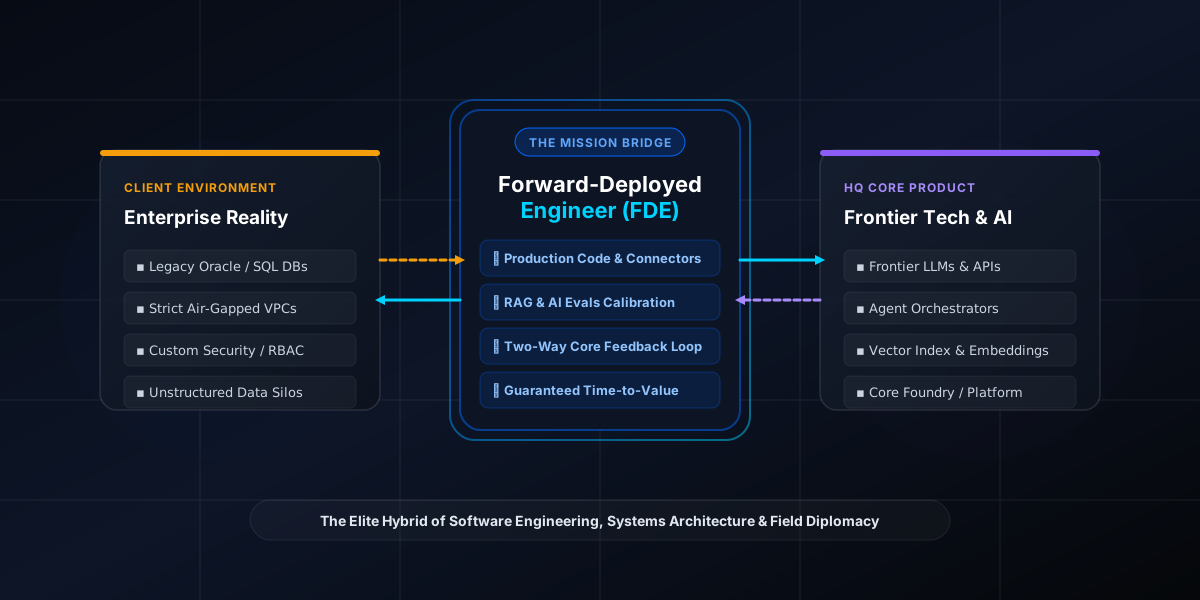
A Forward-Deployed Engineer (FDE) is a full-stack software engineer who is embedded directly on the front lines with a company’s most strategic customers. Unlike traditional software engineers who write code purely for a centralized internal product, FDEs operate at the intersection of deep production software engineering, distributed systems architecture, domain customization, and customer-facing technical leadership.
The term draws inspiration from military strategy, where forward-deployed units operate in direct proximity to active operational zones rather than remote headquarters. In technology, an FDE is dispatched directly into the customer's operational theatre—their private clouds, on-premises datacenters, and internal technical workflows.
"An FDE is not a customer support engineer, and they are not a consultant. An FDE is an elite software engineer whose primary IDE happens to be connected directly to the most challenging, high-stakes customer infrastructure in the world."
The FDE’s dual mandate consists of two equally critical responsibilities:
- Downstream Execution (Customer to Production): Write the bespoke production code, custom data connectors, security adapters, and model evaluations necessary to make complex software work flawlessly within a client’s unique, imperfect infrastructure.
- Upstream Productization (Field to HQ): Identify recurring client friction points, generalize edge-case solutions into core reusable modules, and steer the central product roadmap using empirical, battle-tested field signals.
The Origin Story: From Palantir's Defense Moat to the Generative AI Boom
To understand why the FDE role is dominating modern tech hiring, one must examine its historical evolution across two distinct eras: the Palantir Era (2004–2022) and the Generative AI Renaissance (2023–Present).
1. The Palantir Origin (2004–2020)
The FDE role was pioneered and codified by Palantir Technologies in the mid-2000s. When Palantir began building data integration platforms (Gotham and Foundry) for defense agencies, intelligence communities, and massive enterprises, they encountered a stubborn truth: enterprise data is extraordinarily messy, siloed, and politically guarded.
Off-the-shelf software could not simply be downloaded and expected to work. Palantir realized that selling multi-million-dollar software licenses required deploying top-tier software engineers (internally known as "Delta" engineers) to sit alongside analysts, generals, and executives. These engineers wrote bespoke integration code on-site, built custom ontology pipelines, and proved immediate mission value. This forward-deployed model became Palantir's primary competitive moat and fueled their growth into a multi-billion-dollar enterprise titan.
2. The Generative AI Renaissance (2023–Present)
With the explosion of Large Language Models (LLMs), foundation models, and autonomous AI agents, the FDE role has transitioned from a specialized enterprise niche into the most coveted engineering position in Silicon Valley.
Companies like OpenAI, Anthropic, Scale AI, Databricks, Cohere, Cursor, and Harvey AI have rapidly scaled their Forward-Deployed Engineering divisions. Why? Because foundation models suffer from what the industry calls The AI Last-Mile Problem:
The "Last-Mile" Bottleneck in Enterprise AI
Building a powerful foundation model or API is only 20% of the battle. The remaining 80% is the "last mile": integrating the model with an enterprise’s proprietary data schemas, ensuring strict latency budgets, tuning RAG chunking algorithms, building hallucination guardrails, setting up automated evals, and satisfying stringent SOC2, HIPAA, and GDPR compliance constraints.
Without FDEs on the ground to solve this last mile, enterprise AI contracts languish in endless proof-of-concept (PoC) purgatory. With FDEs, high-growth startups convert 6-figure pilots into 8-figure recurring revenue engines.
The Two-Way Feedback Engine: Bridging Customers and Core Product
The true genius of the Forward-Deployed model lies in the continuous feedback and generalization loop. Traditional SaaS companies often suffer from a severe disconnect between what central product managers think users need and what users actually struggle with in production.
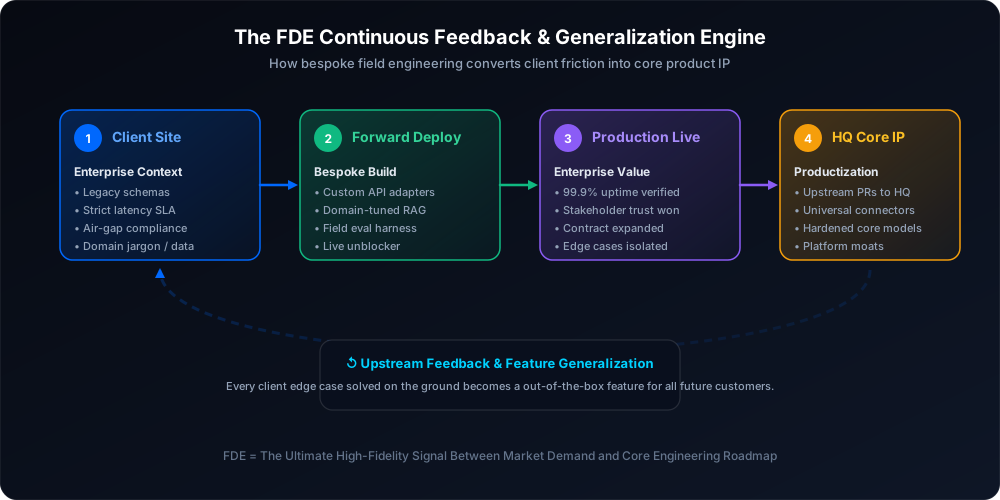
The FDE breaks down this ivory-tower disconnect through a rigorous four-stage feedback loop:
- Immerse in Client Friction: The FDE diagnoses the friction points in the client's native environment—discovering undocumented database nuances, unusual data skew, regulatory barriers, or specialized user ergonomics.
- Rapid Bespoke Engineering: Rather than waiting months for central product changes, the FDE writes immediate, modular adapters, fine-tuning scripts, prompt templates, and middleware directly in the field.
- Production Validation & ROI: The solution is tested with real users, live data, and actual traffic. Uptime, latency, and business KPIs are proven in real time.
- Upstream Core Productization: The FDE extracts the core algorithmic insights from their bespoke fix, strips out client-specific logic, and submits a pull request or architecture spec to HQ engineering. What was built for Client A becomes an out-of-the-box feature for Clients B through Z.
By turning field challenges into centralized product IP, companies with strong FDE cultures build software that matures significantly faster than competitors who rely solely on remote user surveys and telemetry.
A Day in the Life: Inside the Trenches with an FDE
What does an FDE actually do during a normal working day? Here is a chronological look into the multidisciplinary routine of a Senior Forward-Deployed Engineer at a high-growth AI platform company:
Review Grafana dashboards and Datadog traces monitoring the client's dedicated VPC deployment. Check p99 latency spikes, token consumption rates, and automated RAG retrieval recall scores from overnight batch processing runs.
Join an architecture review with the customer’s VP of Enterprise Architecture, CISO team, and Lead Data Engineers. Discuss the roadmap for migrating from a single-region cloud deployment to an air-gapped on-premises Kubernetes cluster. Translate complex security compliance constraints into actionable engineering specs.
Heads-down coding in Python and TypeScript. Build a custom bidirectional streaming connector that ingests messy, unstructured medical records, splits text using semantic chunking boundaries, and pipes vectors into a localized Milvus vector database with zero data leakage.
Run automated LLM evaluation harnesses across 1,500 domain-specific edge-case queries. Calibrate prompt iterations, version system instructions, test few-shot context windows, and verify that hallucination guardrails catch edge cases with >99.4% precision.
Meet with the internal Core Platform team at headquarters. Review a pull request generalizing the semantic chunking engine built earlier in the week, ensuring that it integrates seamlessly into the company's core SDK and cloud platform.
Host a 15-minute live demo for the client's business sponsor (e.g., Head of Global Operations), showing how the new automated workflow cut report generation time from 4 hours to 9 seconds. Reinforce business impact and establish trust for contract expansion.
The Ultimate Comparison: FDE vs. SWE vs. Solutions Architect vs. Consultant
Because the Forward-Deployed Engineer wears multiple hats, it is frequently confused with adjacent technical and customer-facing roles. However, the operational incentives, coding intensity, and lifecycle ownership differ fundamentally.
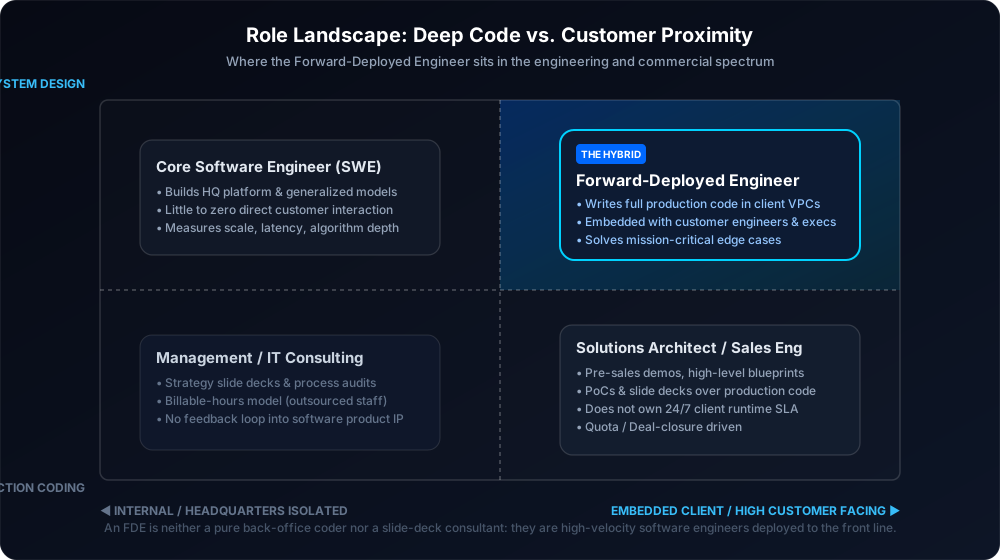
Here is how the Forward-Deployed Engineer stacks up against the rest of the industry:
| Dimension | Forward-Deployed Engineer (FDE) | Core Software Engineer (SWE) | Solutions Architect (SA) | Sales Engineer (SE) | Management Consultant |
|---|---|---|---|---|---|
| Primary Objective | Deliver end-to-end customer production outcomes & feed core IP | Build scalable platform features & internal infrastructure | Design high-level technical blueprints & system architecture | Prove technical feasibility to close sales deals | Provide strategic recommendations & organizational advice |
| Coding Intensity | High (70–80%) Production code, ETL, evals, APIs |
High (85–95%) Central codebase, core platforms |
Low to Moderate (15–30%) Prototypes, PoCs, diagrams |
Low (10–20%) Demos, sandbox scripts |
Zero Slide decks, spreadsheets, frameworks |
| Customer Interaction | Direct & Daily Embedded with client tech teams & execs |
Minimal to None Internal product managers & peers |
High Technical presentations & workshops |
High (Pre-sale) Prospect meetings & pitches |
High Executive interviews & presentations |
| Production Ownership | Yes Owns client deployment uptime & runtime SLAs |
Yes Owns central service availability |
No Advisory handoff to client team |
No Handoff post-deal signature |
No Leaves after report delivery |
| Ambiguity Level | Extreme No clear specs; messy legacy stacks |
Moderate Curated sprint backlogs & PRDs |
Moderate Standard patterns & reference designs |
Low to Moderate Defined product capability demos |
High Broad business problems |
| Compensation Model | Base + Tier-1 Equity / Bonus (High Base) | Base + Equity (Standard Tier-1 Eng) | Base + Performance Bonus | Base + Commission / Quota Variable | Base + Performance Bonus (Hourly Billing) |
Key Nuances You Need to Know:
- FDE vs. Core SWE: A Core SWE is an expert at building for the "happy path" of massive scale (e.g., 100,000 requests per second under uniform cloud conditions). An FDE is an expert at building for the "unhappy path" of enterprise complexity (e.g., low-throughput, highly heterogeneous data structures, strict air-gaps, custom cryptographic standards).
- FDE vs. Solutions Architect: SAs draw the blueprints; FDEs pour the concrete, wire the electricity, and debug the plumbing when the pipes burst.
- FDE vs. Sales Engineer: SEs operate in the pre-sales cycle trying to get a contract signed. FDEs enter during or immediately after the sale to ensure the contract actually succeeds in reality.
The FDE Skill Stack: The Ultimate T-Shaped Engineer
Becoming an exceptional Forward-Deployed Engineer requires a rare combination of deep technical fundamentals and executive-level emotional intelligence (EQ). Top recruiters evaluate FDE candidates across two distinct pillars:
1. Technical Depth (The Hard Skills)
- Full-Stack & Systems Programming: Fluency in Python, TypeScript/JavaScript, and systems languages like Go or Rust. Mastery of asynchronous I/O, concurrency, memory profiling, and REST/gRPC API development.
- Modern Cloud & Container Infrastructure: Deep familiarity with AWS, Microsoft Azure, Google Cloud Platform (GCP), Docker, Kubernetes, Terraform, and VPC networking. Ability to navigate complex VPNs, private subnets, IAM roles, and air-gapped on-prem environments.
- Modern AI & LLM Engineering:
- Retrieval-Augmented Generation (RAG) architecture, semantic chunking, and dense/sparse hybrid search.
- Vector databases (Milvus, Pinecone, Qdrant, Weaviate, pgvector).
- Automated model evaluation harnesses (measuring precision, recall, hallucination rates, NDCG, faithfulness).
- Prompt engineering orchestration, tool calling, JSON schema enforcement, and latency caching.
- Data Engineering & ETL: Experience wrangling messy SQL/NoSQL databases, Kafka/RabbitMQ event streams, unstructured file formats, and high-throughput data normalization.
2. Consultative & Soft Skills (The Diplomatic Skills)
- Executive Translation: The ability to explain complex trade-offs (e.g., latency vs. accuracy in model quantization) to non-technical C-suite executives in plain financial terms.
- Radical Autonomy & Ambiguity Tolerance: Thriving in environments where there is no user story, no documentation, and no clear instructions—just an unhappy customer and a broken pipeline.
- Crisis Management: Remaining calm, methodical, and communicative when a production outage occurs during high-stakes executive testing.
- Product Intuition: Knowing when a bespoke customer request is a true generalizable product requirement versus when it is an anti-pattern that should be politely redirected.
Compensation Benchmarks & Salary Trends (2024–2026)
Because the intersection of high-end software engineering and high-touch customer communication is notoriously difficult to find, Forward-Deployed Engineers command some of the highest compensation packages in the global technology sector.
Market data across leading AI labs, defense-tech companies, and enterprise SaaS providers indicates the following total compensation (TC) benchmarks (inclusive of base salary, annual bonuses, and equity grants):
At frontier AI labs such as OpenAI, Anthropic, and Scale AI, equity grants for FDEs frequently mirror core research and engineering compensation because these engineers are directly responsible for deploying frontier models at massive commercial scale.
Career Progression & Exit Pathways: The Fast Track to Leadership
Working as a Forward-Deployed Engineer is widely recognized as one of the fastest career accelerators in modern technology. Because FDEs gain deep mastery over the entire product lifecycle—from code architecture to customer economics and executive negotiation—their exit opportunities are exceptionally broad.
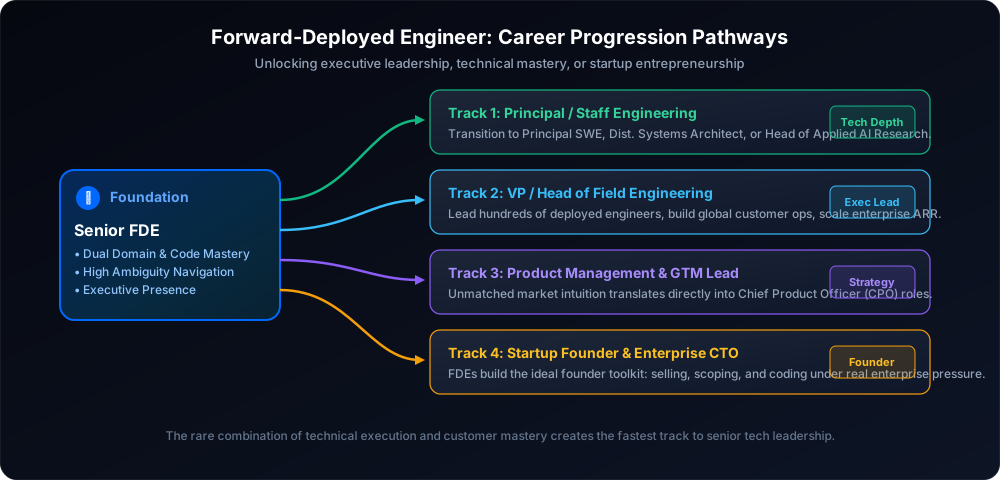
1. The Technical Leadership Track (Staff / Principal Engineer)
Engineers who prefer deep technical craftsmanship can advance into Staff FDE, Principal Solutions Architect, or Principal Systems Engineer roles. In these positions, they architect multi-million-dollar deployments, mentor junior engineers, and design universal integration frameworks across entire industry verticals.
2. The Field & Commercial Executive Track (VP of Field Engineering)
FDEs who enjoy organizational design and business scaling frequently advance to Head of Field Engineering, VP of Professional Services, or Chief Customer Officer (CCO). They build global deployment divisions, oversee enterprise customer success, and partner directly with sales leadership to drive enterprise net revenue retention (NRR).
3. The Product Leadership Track (CPO / Group Product Manager)
Few people understand market needs better than an FDE who has spent three years fixing customer edge cases. FDEs frequently transition into senior Product Management (PM), Director of Product, or Chief Product Officer (CPO) positions, where their acute sense of user friction enables them to build best-in-class products.
4. The Entrepreneurship Track (Startup Founder & CTO)
The FDE role is the ultimate training ground for venture-backed founders. An FDE knows how to write production software, sell to enterprise buyers, navigate compliance, and handle live customer fires. A disproportionate number of enterprise SaaS and AI startup founders began their careers as forward-deployed engineers at Palantir, Scale AI, and Databricks.
Real-World Case Studies: How FDEs Save Multi-Million Dollar Deals
Case Study 1: Deploying a Legal AI Agent in a Multi-Tenant Law Firm
The Scenario: A top-10 international law firm wanted to deploy an automated contract review agent. However, strict attorney-client privilege rules required that documents from conflicting clients must never share vector indices, cache storage, or cross-tenant context.
The FDE Intervention: The FDE designed an ephemeral, single-tenant container orchestration layer that dynamically spun up isolated vector indices inside encrypted RAM disk instances, executed prompt evaluations, verified citation provenance, and shredded memory buffers immediately upon session termination.
The Outcome: The firm passed all bar association confidentiality audits, saving 12,000 billable partner hours annually and turning a 30-day trial into an 8-figure 5-year enterprise rollout.
Case Study 2: Air-Gapped Intelligence Processing in Defense Tech
The Scenario: A defense contractor needed real-time computer vision and geospatial analysis deployed on edge hardware inside field command units without public internet access.
The FDE Intervention: The FDE containerized the entire inference pipeline, developed a localized quantization pipeline to compress 70B parameter models onto edge GPU clusters, and built offline synchronization protocols that queued telemetry until physical link reconnects.
The Outcome: The system achieved zero-downtime offline operational capability, proving mission resilience in harsh edge environments.
How Modern Developer Tools Empower the Next Generation of FDEs
As the velocity of field deployments accelerates, Forward-Deployed Engineers rely heavily on modern tooling to manage complexity. In the AI era, one of the biggest challenges for FDEs is prompt management, iteration tracking, and system instruction version control across dozens of disparate client environments.
When an FDE is tuning domain-specific prompts for five different enterprise clients—each with subtle tone requirements, safety guardrails, and schema structures—relying on messy scratchpads or unstructured notes leads to regressions and configuration drift.
This is where specialized tools like Promptnote come into play. By providing a lightweight, 100% local prompt management library with built-in version control and an instant global Quick Picker shortcut (Ctrl+Shift+P), engineers can organize, test, preview, and restore battle-tested prompt iterations across client sandboxes without breaking their flow or exposing confidential customer data to third-party clouds.
Pro-Tip for Field Engineers: Version Control Your System Prompts
Treat your system prompts, evaluation benchmarks, and RAG schemas with the same rigor as compiled code. Always track incremental prompt adjustments, test edge cases systematically, and maintain a centralized, reproducible prompt library for rapid field deployment.
Frequently Asked Questions (FAQ)
❓ Do Forward-Deployed Engineers write real production code or just glue scripts?
FDEs write genuine, mission-critical production code. While they certainly write connectors and API adapters, they also build high-throughput data ingestion pipelines, low-latency streaming middleware, custom model evaluation engines, and secure authentication proxies. Their code runs directly in enterprise production systems handling millions of dollars in transactions.
❓ Is being an FDE a dead end if I want to stay in pure software engineering?
Not at all. In fact, FDEs often become better systems engineers because they have experienced real-world failure modes that never occur in clean test environments. Many FDEs successfully rotate back into core engineering as Lead or Staff Software Engineers, bringing unmatched domain knowledge and architectural resilience.
❓ How much travel is typically required for an FDE role?
Travel requirements vary by company and sector. Defense and intelligence FDEs may spend 40–70% of their time on-site due to air-gapped security protocols. In contrast, modern AI and SaaS startups frequently operate with a hybrid model where 70–80% of deployment work is done remotely via secure cloud access, with travel reserved for kickoff architecture sprints and critical executive go-lives.
❓ How do I prepare for a Forward-Deployed Engineer interview?
FDE interviews test both deep coding fundamentals and system design under ambiguity. Prepare for:
- Data Structures & Algorithms: Standard LeetCode Medium/Hard algorithmic proficiency.
- System Design: Real-world distributed systems design, data pipelines, caching, and VPC security architectures.
- Applied AI / RAG Scenarios: Designing retrieval pipelines, evals, and handling latency constraints.
- Behavioral & Stakeholder Scenarios: Explaining technical failures to non-technical leaders and resolving competing client priorities.
❓ What is the difference between an FDE at Palantir and an FDE at OpenAI?
At Palantir, FDEs focus heavily on enterprise data integration, ontology construction, and large-scale operational analytics using the Foundry and Gotham platforms. At OpenAI or Anthropic, FDEs specialize deeply in foundation model integration, custom fine-tuning, RAG optimization, prompt orchestration, and building production-grade agentic workflows on top of frontier LLM APIs.
❓ Why is the FDE role considered the best stepping stone to becoming a founder?
Startups fail most often from building things nobody wants. FDEs spend years listening to paying customers, understanding enterprise willingness-to-pay, navigating procurement, and executing under extreme pressure. This unique blend of builder skills and commercial empathy produces world-class technical founders.
Final Thoughts: The Future Belongs to the Engineer-Diplomat
As software and artificial intelligence grow exponentially more powerful, the gap between what technology can do in theory and what enterprises can absorb in practice is widening. The companies that dominate the next decade will not simply be the ones with the largest compute clusters or the most elegant GitHub repositories.
They will be the companies with the most effective Forward-Deployed Engineers—the builders who roll up their sleeves, step onto the front line, tame the chaos of legacy enterprise infrastructure, and deliver real, measurable value where it matters most.
Whether you are an engineer looking to maximize your career impact or a company building the future of enterprise software, embracing the forward-deployed paradigm is no longer optional. It is the ultimate bridge to production reality.
Related articles & guides