
1. The Evolutionary Journey: Prompt → Loop → Graph
Over the past four years, AI engineering has undergone two fundamental paradigm shifts. Each shift was prompted by the exact same realization: foundation models are brilliant cognitive components, but terrible workflow engines.
To understand why the industry is rapidly standardizing on Graph Engineering in 2026, we must first trace how we got here:
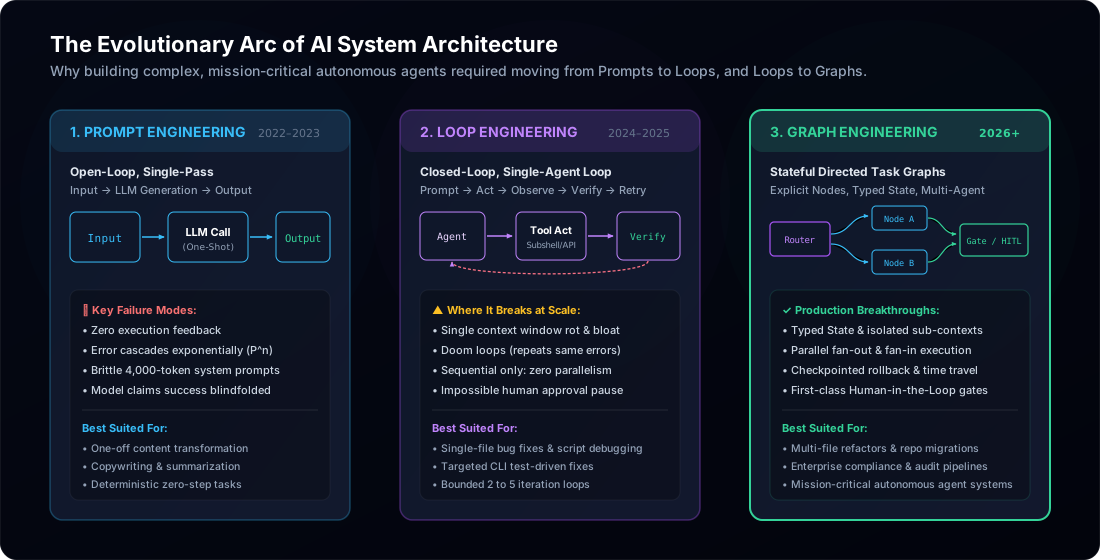
Era 1: Prompt Engineering (2022–2023) — The Illusion of the Perfect Prompt
In the dawn of modern LLMs, we treated AI as an oracle. The developer's job was crafting the optimal natural language input—packing few-shot examples, role definitions, and strict XML constraints into a single request.
This was an open-loop system. The model generated an answer blindfolded. If the generated code contained a syntax error or hallucinated a library, the system had no mechanism to catch it. As demonstrated in our guide to Loop Engineering, an open-loop system with 10 sequential decisions and a 95% step accuracy has an end-to-end success rate of barely 59%.
Era 2: Loop Engineering (2024–2025) — The Closed-Loop Feedback Era
To overcome open-loop failure, developers wrapped models in iterative loops: Prompt → Act → Observe → Verify → Retry → Stop. Powered by patterns like ReAct (Reasoning + Acting) and tools like automated test runners, the model was given bash subshells, linters, and compiler output.
Loop engineering pushed SWE-bench solve rates from 4% to over 50%. For targeted, single-file bug fixes, a closed while-loop was revolutionary. But as teams pushed agent loops to handle 50-file migrations, multi-step cloud deployments, or complex enterprise audits, the single loop hit an impenetrable ceiling.
Era 3: Graph Engineering (2026+) — Explicit Task Topologies
When a complex task is shoved into a single while-loop, the agent's context window becomes a dumping ground for hundreds of unrelated tool calls, compiler errors, and reasoning traces. The agent begins repeating mistakes, forgets its original objectives, and cannot parallelize independent steps.
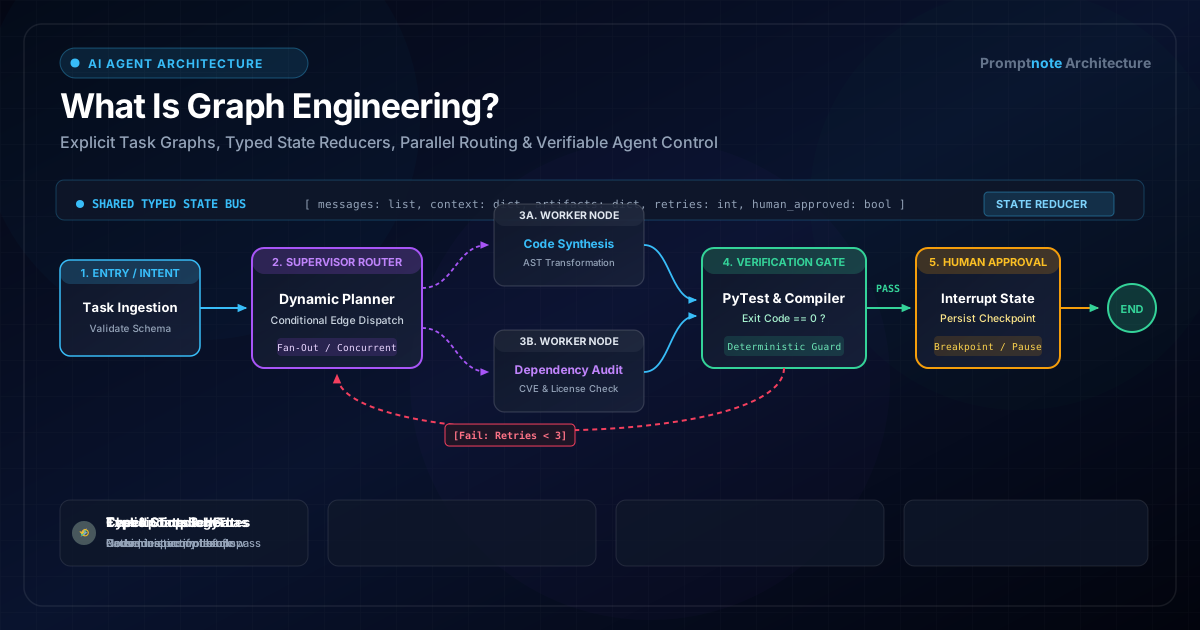
Graph Engineering takes the lessons of software architecture, statecharts, and distributed systems, and applies them to AI agents. Instead of letting one LLM manage an amorphous, unbounded loop, we design an explicit directed computation graph:
- Discrete Nodes specialize in specific subtasks (e.g., Architect, Coder, Linter, Test Runner, Security Scanner).
- Typed State Schemas pass strictly validated context between steps without polluting the global prompt.
- Conditional Edges route execution deterministically based on algorithmic checks rather than model whim.
- Parallel Branches fan out independent tasks across concurrent workers and join results cleanly.
- Checkpoints & Human Gates allow the system to freeze, save state to disk, and await engineer sign-off before committing dangerous operations.
2. The Breaking Point: Why Single Agent Loops Collapse at Scale
To appreciate why graph architectures are necessary, consider what happens under the hood when a single agent loop attempts an enterprise-scale software engineering task—such as migrating a legacy Python 3.8 microservice to Python 3.12 with async SQLAlchemy 2.0.
When a single agent loop attempts multi-phase or multi-file reasoning, it inevitably encounters five systemic failure modes:
Context Window Rot & Bloat
In a single loop, every tool execution, stack trace, and 500-line test log is appended to the message history. By iteration 14, the model is drowning in 90k tokens of failed attempts, causing attention degradation and prompt injection from stale logs.
Doom Loops & Thrashing
Without explicit state boundaries, agents lack historical memory of past attempts. Fixing test A breaks test B; fixing test B breaks test A. The agent enters an endless oscillation, consuming thousands of dollars in tokens without progressing.
Sequential Bottleneck (Zero Concurrency)
A while-loop is inherently serial. If an agent needs to inspect 12 separate microservices, run 4 independent linters, and generate documentation, it must execute each one sequentially, turning a 30-second job into a 15-minute wait.
Unobservable Black Box Execution
When an autonomous agent runs in a monolithic loop, debugging is a nightmare. There are no discrete function boundaries, no isolated unit tests for sub-steps, and no way to inspect which sub-decision triggered a catastrophic failure.
Impossible Human Approvals
How do you pause a live Python while-loop for 4 hours while an engineer reviews a database migration script? In a basic loop, state is in volatile RAM. Graph architectures persist state checkpoints to durable storage natively.
These breakdown points are not model intelligence failures. They are software architecture failures. When software complexity increases, traditional developers don't write one 10,000-line main() function with 40 nested while-loops. We decompose the problem into modular components, define strict interface contracts, and route execution deterministically. That is the essence of Graph Engineering.
3. What Is Graph Engineering? The Core 2026 Definition
In computer science, a graph consists of a set of vertices (nodes) connected by directed links (edges). In control theory and systems architecture, statecharts and directed acyclic graphs (DAGs) have long powered workflow orchestration engines like Apache Airflow, Temporal, and compiler intermediate representations (IR).
Applying this discipline to autonomous agents produces the formal definition of Graph Engineering:
Graph Engineering is the discipline of architecting, compiling, and executing agentic AI systems as explicit stateful task graphs — where computational steps, LLM cognitive reasoning, deterministic tools, and human approvals are represented as discrete nodes, transitions are governed by typed conditional edges, and shared context is updated through formal state reducers and persistent checkpoints.
Where prompt engineering focuses on the message sent to a model, and loop engineering focuses on the while-loop running around a model, graph engineering focuses on the macroscopic topology and state machine that coordinates entire multi-agent ecosystems.
- Explicit Topology: No hidden loops or implicit agent prompts. Every valid state transition, fallback path, and exit condition is declared explicitly in the graph schema.
- Scoped Sub-Contexts: Instead of one giant prompt accumulating garbage, each node receives only the minimal slice of state necessary for its task.
- Deterministic Guardrails: Routing between nodes is evaluated with deterministic Python code, regex, schema checkers, or exit codes—not probabilistic guesswork.
- Durable Time-Travel: Graph execution is saved at every node boundary, allowing instant rollbacks, session pausing, and hot-swapping failed nodes without restarting.
4. The Critical Distinction: Execution Graphs vs. Knowledge Graphs vs. GraphRAG
Because the word “Graph” is heavily overloaded in artificial intelligence, software engineers frequently confuse Graph Engineering with Knowledge Graphs or GraphRAG.
Conflating these concepts leads to severe architectural mistakes. Let's make the distinction crystal clear:
| Dimension | Task / Execution Graphs (Graph Engineering) | Knowledge Graphs (KG) | GraphRAG |
|---|---|---|---|
| Primary Purpose | Workflow Orchestration & Agent Control. Governs how tasks execute, route, verify, and complete. | Factual Data Representation. Encodes relationships between real-world entities (ontologies). | Information Retrieval. Augments LLM prompts by traversing entity relationship graphs. |
| What are the Nodes? | Computational Actions: LLM calls, Python scripts, test runners, API requests, human approval gates. | Entities & Concepts: e.g., User(Vivek), Company(Promptnote), City(San Francisco). |
Document chunks, extracted entities, and community topic clusters. |
| What are the Edges? | Control Flow & Transitions: Conditional jumps, parallel forks, error backtracks, sequence arrows. | Semantic Predicates: e.g., WORKS_AT, LOCATED_IN, SUBSIDIARY_OF. |
Semantic associations, co-occurrences, and cross-document citation links. |
| State Concept | Runtime Execution State: Memory dictionary, accumulated messages, git diffs, retry counters. | Persistent Database State: Graph database (Neo4j, Memgraph, Amazon Neptune). | Vector index + Knowledge Graph database schema. |
| Primary Tools & Frameworks | LangGraph, LlamaIndex Workflows, DSPy, temporal state machines, AWS Step Functions, custom DAG engines. | Neo4j, RDFLib, SPARQL, Ontotext GraphDB, NetworkX. | Microsoft GraphRAG, LlamaIndex Property Graph, Auto-KG RAG. |
| Can They Co-Exist? | Yes! A single node inside an Execution Graph can execute a GraphRAG query against a Knowledge Graph database to retrieve context before generating a report. Graph Engineering orchestrates the entire agent, while GraphRAG is merely one tool in its belt. | ||
Think of an Execution Graph as the automated assembly line of a car factory: sheet metal enters, robots stamp the frame, painters spray the coat, quality inspectors test the welds, and cars that fail inspection are diverted to a rework station.
A Knowledge Graph is the factory's inventory ledger: a database recording which parts fit into which engines. Graph Engineering is designing and managing the assembly line.
5. The Anatomy of an Execution Graph: 8 Foundational Primitives
To construct high-reliability agents, graph engineers work with eight core primitives. Every sophisticated agentic framework—from LangGraph to proprietary production harnesses—builds upon these foundational elements:
1. Nodes: Discrete Computational Steps
A node is an isolated function that accepts the current state, performs a specific operation, and returns an updated partial state. Nodes come in three flavors:
- Cognitive Nodes: Prompts an LLM for structured reasoning, code generation, or natural language classification.
- Deterministic Nodes: Executes pure code without an LLM—running
pytest, formatting JSON, pulling a git commit, or querying a SQL database. - Sub-agent Nodes: Encapsulates an entire nested child graph running as a single black box inside the parent graph.
2. Edges: Directed Control Flow
Edges determine where execution proceeds after a node finishes. In graph engineering, edges are never arbitrary:
- Standard (Direct) Edges: Unconditional sequence. Node A always transitions to Node B (e.g.,
Linting → TestRunner). - Conditional Edges: Dynamic routing functions that evaluate state variables and return the name of the next destination node (e.g., if
test_exit_code == 0go toDeploy, else go toDebugger).
3. State & Reducers: The Typed Context Bus
Instead of maintaining a messy list of raw strings, execution graphs operate over a strongly-typed state schema (using Pydantic, Python TypedDict, or TypeScript interfaces).
Crucially, updates are handled by State Reducers. When a node outputs data, the reducer dictates whether the value overwrites the existing state, appends to a list (like an immutable message queue), or merges with existing dictionary keys. This prevents sub-agents from accidentally clobbering each other's data.
4. Dynamic Routing: Intent Triage and Sharding
Rather than asking a single generalist prompt to handle customer support, billing, database maintenance, and security, a Triage Router Node classifies the user's intent and dispatches execution to an isolated, domain-specific subgraph. The billing subgraph only has access to Stripe APIs, while the security subgraph only has access to IAM logs.
5. Parallel Execution: Fan-Out and Fan-In
Unlike sequential loops, graph edges can fan out to multiple destination nodes simultaneously. If an engineer asks an agent to audit a codebase, the graph can trigger 4 parallel workers concurrently:
Worker Achecks Python syntax and deprecations.Worker Bscans for hardcoded API secrets with git-leaks.Worker Cchecks dependency licenses for GPL compliance.Worker Dmeasures test coverage percentages.
Once all four workers complete, a Fan-In Join Node aggregates their reports into an executive summary. Total execution time equals the single slowest check, rather than the sum of all four.
6. Verification Gates: Test Runners & Compilers
A Verification Gate is a deterministic checkpoint that verifies agent work before allowing the graph to advance. The gate does not use an LLM; it executes a compiler, unit test suite, or schema validator:
- If the test runner returns exit code
0, the edge transitions to the success path. - If the test runner fails, the exact terminal stdout/stderr is packaged into state, and the edge routes back to a specialized debugging node.
7. Retries, Backtracking & Circuit Breakers
Cycles in graphs allow agents to self-correct, but unchecked cycles become expensive doom loops. Graph engineering requires circuit breakers:
def route_after_verification(state: AgentState) -> str:
    if state["tests_passed"]:
        return "human_approval"
    elif state["retry_count"] >= state["max_retries"]:
        return "escalate_to_human"  # Circuit breaker tripped
    else:
        return "debugger_agent"       # Backtrack and retry
8. Human-in-the-Loop (HITL) Checkpoints & Time Travel
The most powerful capability of graph engineering is state persistence. Modern graph engines store the complete state snapshot to a persistent store (Postgres, SQLite, or Redis) after every single node execution.
This enables interrupt_before=["production_deploy"]: the graph runs autonomously through planning, coding, and testing, then pauses. An engineer reviews the pull request on a dashboard, edits any state parameters if needed, and clicks "Approve." The graph resumes execution instantly from the exact saved checkpoint.
6. Six Core Graph Engineering Design Patterns
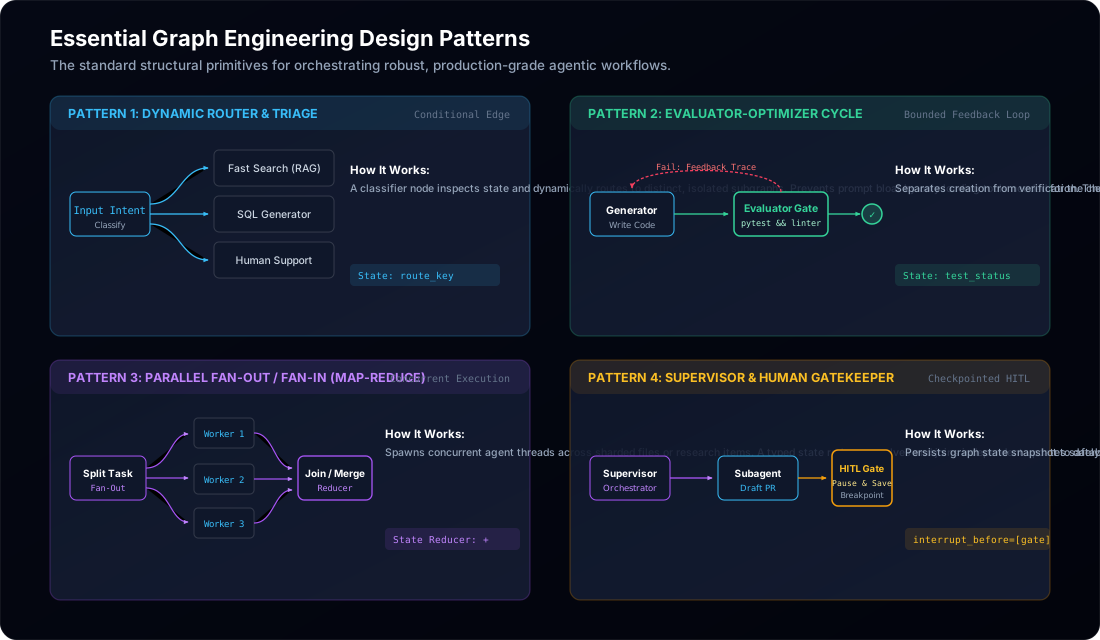
Just as object-oriented programming developed Gang of Four patterns (Factory, Singleton, Adapter), Graph Engineering has established six standard architectural patterns in production:
1. The Router / Triage Pattern
An incoming request enters a specialized classification node that chooses between $N$ distinct downstream execution paths. By sharding execution immediately, you prevent tool-definition bloat. A model with 50 tools experiences severe tool-selection hallucination; a model routed to a subgraph with only 3 targeted tools achieves 98%+ tool accuracy.
2. The Evaluator-Optimizer (Generator-Critic) Cycle
One of the highest-performing patterns in SWE-bench benchmarks. A Generator Node produces candidate code or content. An Evaluator Node independently inspects the work against explicit unit tests or deterministic criteria. If verification fails, the error traceback is routed to an Optimizer Node, creating a tightly bounded, self-correcting cycle.
3. The Parallel Map-Reduce (Fan-Out / Fan-In)
Used for large documents, extensive codebases, or bulk research. The initial task is decomposed into an array of $M$ independent chunks. The graph fans out into $M$ parallel node instances running concurrently. A reducer node captures all outputs, resolves merge conflicts, and synthesizes the final artifact.
4. The Supervisor / Multi-Agent Orchestrator
A central Supervisor Node acts as tech lead. It maintains the master plan and delegates tasks to specialized sub-agents (e.g., Frontend Specialist, Backend Specialist, DevOps Engineer). Each specialist runs its own localized subgraph and returns its completed state update back to the supervisor.
5. The Human Gatekeeper (Checkpoint & Resume)
A safety-critical pattern for high-risk operations. The graph executes up to a predefined breakpoint, freezes its thread in a database checkpoint, and alerts human operators via Slack, email, or a web UI. The operator can inspect intermediate state, edit parameters, approve, or reject. Upon webhook receipt, the graph resumes seamlessly.
6. Hierarchical Subgraphs (Composite Graphs)
Complex systems cannot be modeled in a single flat graph with 80 nodes. Graph engineering enables recursive modularity: a single node in a parent graph can be an entire compiled child graph with its own private state schema, internal cycles, and exit conditions. This mirrors microservice architecture for AI agents.
7. Real-World Case Study: An Autonomous CI/CD Migration Agent
To see Graph Engineering in action, consider how a production agent upgrades 200 Python repositories to Python 3.12 with zero human intervention until final approval:
Production Graph Walkthrough: Python 3.12 Migration
-
Ingestion & State Init: Graph clones the repository into an isolated container and initializes
RepoMigrationStatewith repo metadata, commit hashes, and an empty error log. -
Analysis & Planning Node: An LLM inspects
pyproject.tomland requirements, identifying deprecated libraries (e.g.,pkg_resources, obsolete typing imports). Generates a structured migration DAG. - Parallel Fan-Out (File Refactoring): The graph splits modified modules into independent batches and spawns 3 parallel worker nodes to rewrite syntax concurrently using AST transformation tools.
-
Deterministic Verification Gate: A deterministic node runs
ruff check .andpytest tests/in the container:- Case A (Pass): All 142 tests pass cleanly with exit code 0 → Routes to Security Audit Node.
- Case B (Fail): 3 tests fail due to async changes → Tracebacks are injected into
state["pytest_output"]and routed toFixer Node. Circuit breaker limits retries to 3.
- Security & License Audit: A deterministic scanner verifies no new dependencies contain known CVEs or incompatible licenses.
-
Human Gatekeeper (Interrupt): Graph commits to a new git branch, creates a draft GitHub Pull Request, saves checkpoint ID
chk_88f9a2, and pauses. - Human Approval & Merge: Senior engineer clicks "Approve PR" in GitHub. A webhook wakes the graph thread from its checkpoint, which completes the merge and closes the task.
Attempting this workflow inside a single while-loop or prompt is virtually guaranteed to fail. With Graph Engineering, each phase is isolated, testable, reproducible, and verifiable.
8. Comprehensive Comparison Matrix: Prompts vs. Loops vs. Graphs
Here is how the three generations of AI development compare across every critical software engineering dimension:
| Engineering Dimension | Prompt Engineering | Loop Engineering | Graph Engineering |
|---|---|---|---|
| Execution Paradigm | Open-Loop, Single-Pass | Closed-Loop, Single While-Loop | Stateful Directed Graph / Statechart |
| Task Complexity Limit | 1–2 discrete steps | 3–8 steps (single file scope) | 50+ steps (cross-system, multi-repo) |
| State Management | Stateless (lost after single call) | Volatile in-memory message list | Strongly-typed schemas with reducers & persistence |
| Concurrency & Parallelism | None (Single query) | Sequential only (one tool at a time) | Native Fan-Out / Fan-In concurrency |
| Error Recovery & Retries | None (User must re-prompt) | Ad-hoc prompt retries; prone to doom loops | Explicit fallback edges, circuit breakers & rollbacks |
| Human-in-the-Loop (HITL) | Manual copy-pasting | Blocking console input (fragile) | Asynchronous checkpoints, pause & resume APIs |
| Observability & Debugging | Low (Inspect single output) | Moderate (Inspect long message trace) | High (Inspect exact node inputs, outputs & transitions) |
| Token Cost Efficiency | High per call, but high failure rate | Low (Message history balloons with failed logs) | Optimal (Scoped sub-contexts keep prompt tokens lean) |
9. When NOT to Use Graph Engineering (Anti-Patterns & Overhead)
Graph Engineering is a powerful architectural pattern, but it introduces architectural complexity. Applying a complex multi-agent graph to a trivial task is a classic software engineering anti-pattern.
Every graph node incurs serialization overhead, state synchronization, and operational maintenance. Do NOT reach for Graph Engineering if:
- The Task is Linear and Predictable: If your task is simply Input → RAG Retrieval → LLM Answer, write a clean 30-line Python function. Wrapping this in a graph framework adds latency, dependency bloat, and cognitive friction for zero reliability gain.
- Ultra-Low Latency is Required (<500ms): Graph state checks, database checkpointing, and dynamic dispatchers add milliseconds of execution overhead. For real-time conversational voice agents or autocomplete APIs, stick to streaming lightweight pipelines.
- Single-Step Transformations: Tasks like summarization, text translation, markdown reformatting, or single-field extraction belong in standard Prompt Engineering.
- Small, Localized Script Fixes: If you are building a lightweight CLI utility that runs a command and fixes syntax errors in 2 iterations, a simple Loop Engineering while-loop is simpler, faster, and easier to maintain.
10. Practical Implementation: Building a Production Execution Graph
Let's look at a concrete, production-style implementation using a modern graph pattern. This example demonstrates typed state schemas, reducer functions, deterministic test verification, and conditional edge routing with circuit breakers:
from typing import TypedDict, Annotated, List, Literal
from operator import add
import subprocess

# 1. Define Strongly-Typed State Schema
class CodeMigrationState(TypedDict):
    task_description: str
    target_file: str
    code_content: str
    test_logs: Annotated[List[str], add]  # Reducer: appends logs rather than overwriting
    retry_count: int
    max_retries: int
    status: Literal["in_progress", "passed", "failed_max_retries"]

# 2. Define Node: Code Synthesizer (LLM or AST tool)
def code_generator_node(state: CodeMigrationState) -> dict:
    print(f"[Node: Generator] Iteration {state['retry_count']}: Refactoring {state['target_file']}...")

    # In production, this prompts your frontier LLM with state["task_description"]
    # and only the relevant slice of state["test_logs"]
    generated_code = """
def calculate_metrics(values: list[float]) -> dict[str, float]:
    if not values:
        raise ValueError("Values cannot be empty")
    return {"mean": sum(values) / len(values), "total": sum(values)}
"""
    # Write code to filesystem
    with open(state["target_file"], "w") as f:
        f.write(generated_code.strip())

    return {
        "code_content": generated_code,
        "retry_count": state["retry_count"] + 1
    }

# 3. Define Deterministic Verification Node (PyTest Gate)
def verification_gate_node(state: CodeMigrationState) -> dict:
    print(f"[Node: Verification Gate] Executing pytest on test suite...")

    # Run deterministic test runner in an isolated container or subshell
    result = subprocess.run(
        ["pytest", "tests/test_metrics.py", "-q"],
        capture_output=True,
        text=True
    )

    if result.returncode == 0:
        print("✓ All tests passed!")
        return {
            "status": "passed",
            "test_logs": ["All unit tests passed cleanly with exit code 0."]
        }
    else:
        print("✕ Unit tests failed!")
        return {
            "status": "in_progress",
            "test_logs": [f"Test Failure Traceback:\n{result.stdout}\n{result.stderr}"]
        }

# 4. Define Conditional Edge Router with Circuit Breaker
def route_after_verification(state: CodeMigrationState) -> Literal["human_approval", "code_generator", "escalate_failure"]:
    if state["status"] == "passed":
        return "human_approval"

    if state["retry_count"] >= state["max_retries"]:
        print(f"⚠️ Circuit breaker triggered: Max retries ({state['max_retries']}) exceeded.")
        return "escalate_failure"

    print(f"⟲ Backtracking: Routing back to generator with error feedback.")
    return "code_generator"

# 5. Define Human-in-the-Loop Checkpoint Node
def human_approval_node(state: CodeMigrationState) -> dict:
    print("\n==========================================")
    print("🔔 HUMAN CHECKPOINT: Verified PR Ready for Review")
    print(f"File: {state['target_file']}")
    print("Status: Passed 100% test suite parity.")
    print("==========================================\n")
    return {"status": "passed"}

def escalate_failure_node(state: CodeMigrationState) -> dict:
    print("🚨 Escalating to on-call engineer: Graph was unable to resolve test failures.")
    return {"status": "failed_max_retries"}
Notice how clean this architecture is:
- The model call does not decide when it is finished. The deterministic
verification_gate_nodeverifies reality withsubprocess.run(["pytest", ...]). - The retry condition is not a vague prompt instruction. The circuit breaker is enforced algorithmically in Python.
- State updates are typed and isolated. The reducer
Annotated[List[str], add]guarantees an audit trail of test failures without clobbering the main state variables.
11. Frequently Asked Questions (FAQ)
What is Graph Engineering in AI?
Graph Engineering is the architectural discipline of orchestrating multi-step AI agent workflows as explicit stateful task graphs. It breaks complex autonomous operations into discrete computational nodes (tools, models, validators), typed state schemas, conditional routing edges, parallel branches, and durable checkpoints.
How does Graph Engineering differ from Knowledge Graphs and GraphRAG?
Task/Execution Graphs represent computational workflow control flow (who does what, in what order, and what happens when an error occurs). Knowledge Graphs represent factual domain relationships (entities, nodes, and triples). GraphRAG is a retrieval algorithm that explores a knowledge graph to augment prompt context. Graph Engineering is about agent orchestration, not data storage.
Why is Graph Engineering considered the successor to Loop Engineering?
Loop Engineering proved that agents require closed-loop verification to succeed. However, a single monolithic loop suffers from context window rot, doom loops, zero parallelism, and lack of state persistence. Graph Engineering takes the closed-loop verification concept and generalizes it across a structured, multi-node, parallelized state machine.
What libraries are used for Graph Engineering in 2026?
The most widely adopted open-source frameworks include LangGraph (LangChain's cyclic graph orchestration framework), LlamaIndex Workflows (event-driven, typed workflow graphs), DSPy (declarative graph compilation and prompt optimization), as well as durable execution engines like Temporal and custom enterprise DAG harnesses.
How do you prevent doom loops in agent graphs?
Doom loops are prevented by implementing deterministic circuit breakers in conditional routing edges. By tracking iteration counts, computing hashes of attempted code diffs, or measuring progress deltas, the graph can abort cyclic retries and route directly to a human escalation node when no forward progress is made.
Continue Exploring Modern AI Systems
Deepen your architectural expertise with our guides on autonomous agents, prompting systems, and modern AI engineering.
What Is Loop Engineering?
Understand the foundations of closed-loop agents: prompt, act, observe, verify, retry, and stop before scaling into task graphs.
Read Guide →What Are AI Harnesses?
Explore the runtime environments, sandboxes, memory stores, and guardrails that power resilient graph execution.
Read Guide →AI Engineering Skills Map: Idea to Production
Master the complete 2026 stack: Python async, pgvector, hybrid RAG, LangGraph agents, evals, and LLMOps.
Read Guide →