
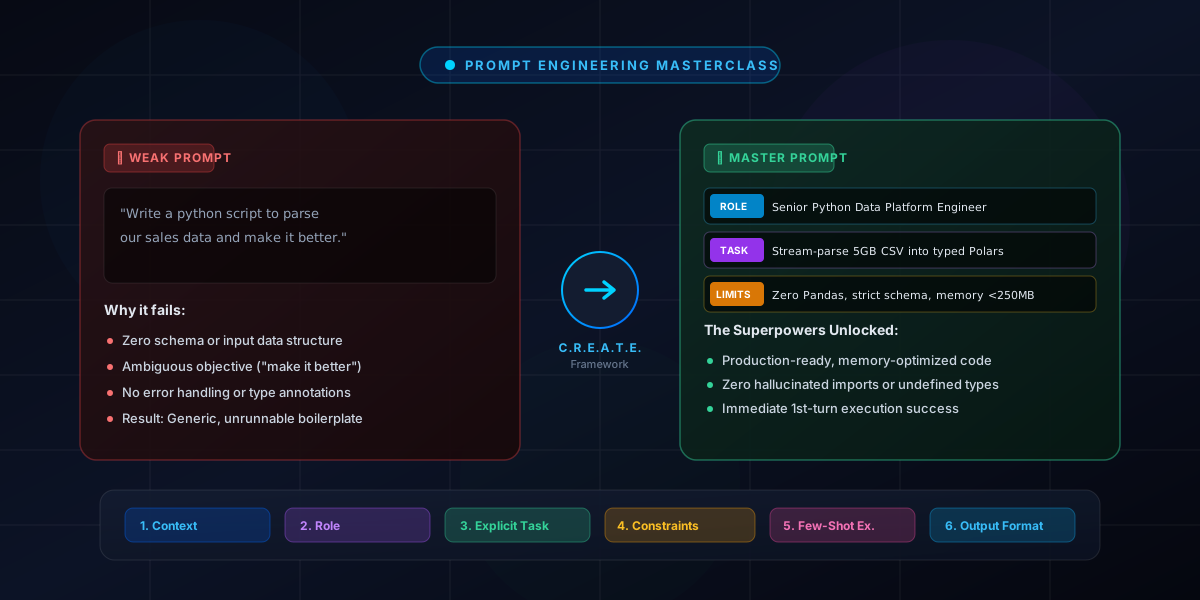
1. The Slot Machine Fallacy & The Art of the Executive Brief
Imagine walking into the office of a world-class principal software engineer or a senior McKinsey management consultant. You walk up to their desk, drop a single piece of crumpled paper that reads "Analyze our sales and write some code to make it faster," and walk away without uttering another word.
Twenty minutes later, you return, inspect their work, and throw your hands up in disgust: "This is completely useless! It's so generic! AI is totally overhyped."
This is the Slot Machine Fallacy. Over 90% of people who interact with modern Large Language Models (LLMs) treat the chat interface like a casino slot machine. They pull the lever with a 5-word, context-deprived sentence, cross their fingers, and hope that mathematical magic will read their mind, guess their tech stack, intuit their brand guidelines, and divine their unspoken business goals.
A state-of-the-art LLM (like GPT-4o, Claude 3.7 Sonnet, or Gemini 2.5 Pro) is not an omniscient crystal ball. It is an infinitely fast, hyper-literate, eager junior specialist with zero domain context. It knows virtually all human public knowledge, but knows nothing about your specific codebase, your target customer, your unspoken constraints, or your stylistic taste unless you provide a clear executive brief.
Writing the best prompt is not about using secret "magic words" or trying to exploit hidden developer backdoors. It is the discipline of clear communication, structured context, unambiguous boundary definition, and precision specification.
When you master this craft, AI transforms from an erratic autocomplete toy into the highest-leverage productivity multiplier of your career.
2. The Anatomical Blueprint: The C.R.E.A.T.E. Prompt Framework
To eliminate the guesswork from prompting, we developed the C.R.E.A.T.E. Framework. Every high-performing prompt across any discipline incorporates these six structural pillars:
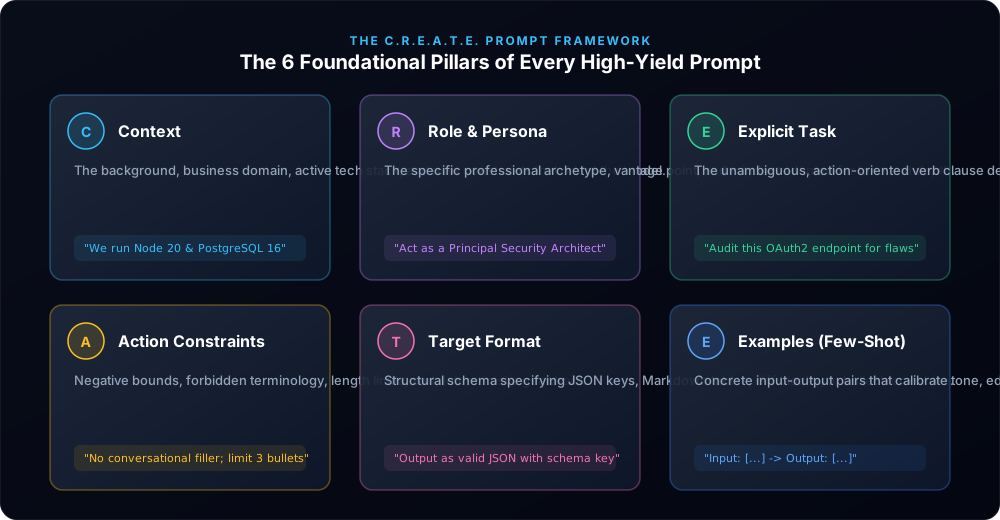
| Pillar | What It Does | What Happens If Omitted | Exemplary Clause |
|---|---|---|---|
| C — Context | Supplies background information, business environment, active tech stack, and incoming source data. | The model makes wild baseline assumptions that rarely match your reality. | "We run an enterprise B2B SaaS on Node.js 20, Postgres 16, and AWS ECS with 45k DAU." |
| R — Role | Calibrates persona, vocabulary, depth of reasoning, and professional perspective. | Generic, kindergarten-level explanations packed with corporate fluff. | "Act as a Principal Staff Site Reliability Engineer specializing in zero-downtime database migrations." |
| E — Explicit Task | Defines the single, unambiguous action verb and primary deliverable required. | The AI answers a different question or wanders across irrelevant subtopics. | "Refactor this legacy query and generate a new execution plan that eliminates full table scans." |
| A — Action Constraints | Sets hard boundaries, forbidden approaches, token budgets, and negative guardrails. | Bloated responses, hallucinated external libraries, or undesirable conversational chatter. | "Do not use ORMs. Rely exclusively on parameterized raw SQL. Do not include conversational intro text." |
| T — Target Format | Dictates exact output layout: JSON schema, Markdown table, unified diff, or executive bullet points. | Unstructured walls of text that cannot be parsed programmatically or skimmed easily. | "Format as a JSON object adhering to the schema: { 'issue': string, 'fix': string, 'diff': string }." |
| E — Examples (Few-Shot) | Provides 1–3 concrete input/output demonstrations to anchor style and edge-case handling. | Higher hallucination rates and subtle stylistic drift. | "Input: '504 Gateway Timeout' -> Output: 'Upstream gateway failed; verify ALB target group health checks.'" |
3. Deep-Diving the 6 Core Building Blocks
Understanding the framework at a high level is only the first step. Let's look at how each component operates mechanically within an LLM's transformer architecture and how to construct each with surgical precision.
3.1 Context Engineering & Delimiter Sandboxing
Large Language Models do not possess persistent episodic memory between sessions. Every request is evaluated purely within the bounds of the tokens supplied in its prompt context window.
When providing context, the biggest mistake is pasting raw unstructured text into the prompt without visual boundaries. The model can struggle to differentiate between your instructions and the data to be processed (a vulnerability that causes both erratic output and prompt injection attacks).
The Fix: Use Clear XML Delimiters or Markdown Fences. Always isolate your data payloads:
3.2 Role Calibration: Beyond Superficial Personas
Telling an AI "You are an expert" is weak because "expert" is too broad. Does an expert mean a university researcher who writes theoretical papers, or a frontline engineer who has debugged production outages at 3 AM?
Effective role prompts specify:
- Seniority & Domain (e.g., "Principal Distributed Systems Architect" vs "Junior Bootcamp Graduate")
- Perspective & Skepticism (e.g., "Review this code from the mindset of a paranoid security auditor looking for remote code execution vectors")
- Target Audience Familiarity (e.g., "Explain this concept to a Series-A Venture Capitalist with finance background but no machine learning experience")
3.3 Actionable Negative Constraints: The "Instead" Principle
Telling an LLM "Don't make it long" or "Don't be boring" frequently backfires. Due to how attention mechanisms work, mentioning concepts (even negatively) can inadvertently prime the model with those exact token patterns.
Whenever you forbid a behavior, immediately prescribe the exact replacement behavior. Instead of writing "Don't use complex words," write: "Avoid academic jargon. Instead, use simple active verbs and concrete everyday analogies suited for an 8th-grade reading level."
3.4 Enforcing Structured Output Schemas
If you plan to use AI outputs inside scripts, spreadsheets, databases, or documentation pipelines, never accept conversational free-form responses. Command the exact shape of the output:
- JSON Outputs: Demand
{ "data": [...] }with explicit key definitions and forbid markdown wrappers if parsing raw HTTP responses. - Tabular Data: Mandate specific markdown columns (e.g.,
| Metric | Current Value | Benchmark | Action Item |). - Zero Conversational Fluff: Add the instruction: "Provide ONLY the requested schema. Do not begin with 'Sure, here is your analysis' or append concluding pleasantries."
3.5 Few-Shot Demonstrations (The Silver Bullet)
In machine learning literature, zero-shot prompting means asking the model to perform a task with zero prior examples. Few-shot prompting means providing 1 to 3 sample input-output pairs inside the prompt.
Empirical research across prompt engineering benchmarks demonstrates that providing just two high-quality examples can increase task accuracy and formatting compliance by upwards of 40% compared to zero-shot instructions.
4. Practical Before-and-After Transformations Across 5 Domains
Theory is meaningless without practical application. Let's examine realistic before-and-after prompt transformations across five major professional fields. Study the side-by-side contrasts to see how applying C.R.E.A.T.E. dramatically elevates output quality.
4.1 Domain 1: Coding & Software Engineering
In software development and modern vibe coding workflows, ambiguous prompts result in unoptimized spaghetti code, missing error handlers, and hallucinated APIs.
Why it fails: No language version specified, no memory limits, no indication of input data scale, and zero code context.
Why it succeeds: Defines runtime environment, memory ceilings, dependency constraints, edge-case failure tolerance, and benchmark formatting.
4.2 Domain 2: Professional Writing & Copywriting
When asking AI to write content, generic prompts produce sterile, cliché-ridden essays filled with phrases like "In today's fast-paced digital landscape" or "Delve into the vibrant tapestry."
Why it fails: Produces hype-filled corporate marketing drivel with no target audience, no value proposition, and no distinct voice.
Why it succeeds: Provides exact pricing, audience pain points, banned buzzwords, word count ceilings, and multiple split-test subject line variations.
4.3 Domain 3: Research & Academic Synthesis
AI excels at synthesizing complex papers, provided you constrain its interpretation and force it to audit methodologies rather than blindly agreeing with conclusions.
Why it fails: Merely generates three separate superficial bulleted summaries without synthesizing trade-offs or identifying methodological flaws.
Why it succeeds: Forces cross-document synthesis, contradiction detection, and renders an executive decision matrix.
4.4 Domain 4: Data Analysis & Strategic Decision-Making
Raw numbers mean nothing without business context. High-yield data analysis prompts force the AI to isolate root causes and suggest measurable interventions.
Why it fails: Without raw metrics, customer segment breakdowns, or time windows, the model produces generic textbook reasons for churn.
Why it succeeds: Feeds hard operational data points, filters out superficial suggestions, and frames output into an executive action plan.
4.5 Domain 5: Everyday Tasks & Workflow Automation
Whether preparing a high-stakes executive meeting agenda or triaging a messy inbox, structured prompts save hours of administrative cognitive load.
Why it fails: Results in chronological rambling with equal weight given to small talk and multi-million dollar architectural decisions.
Why it succeeds: Categorizes ambiguous human discussions into clear owners, hard deadlines, and explicit decision records.
5. The 5 Deadliest Prompt Mistakes (And Exactly How to Fix Them)
The Symptom: Prompts like "Write an article about AI productivity" or "Review this resume."
The Fix: Apply the "Need to Know" rule. Ask yourself: If I gave this task to a remote contractor who has never seen my company, what 3 critical facts would they need to avoid failing? Include those 3 facts explicitly.
The Symptom: Dumping 40 pages of irrelevant documentation and burying your core instruction on page 23.
The Fix: Attention mechanisms exhibit the "Lost in the Middle" phenomenon — LLMs recall tokens placed at the very beginning and very end of the prompt significantly better than middle tokens. Always place your instructions and schemas at the bottom, after the context data payloads.
The Symptom: "Write an extremely detailed, comprehensive 5,000-word analysis that is quick and easy to read in 2 minutes."
The Fix: Resolve internal tensions before prompting. If you want depth with fast scannability, instruct: "Provide an exhaustive technical breakdown, but structure it with an upfront 3-bullet executive TL;DR followed by nested collapsible headings."
The Symptom: Prompts requesting "Make it sound professional" or "Sound engaging."
The Fix: Tone adjectives are subjective. Replace vague descriptors with concrete style anchors (e.g., "Write in the clear, understated, data-first editorial style of The Economist" or "Write in short, punchy, active-voice sentences inspired by Paul Graham's essays").
The Symptom: Giving up after a single turn when the output is 80% correct instead of steering the model.
The Fix: Treat prompting as a collaborative steering loop. Prompting is a dialogue, not a static query.
6. The 4-Step Iterative Prompt Refinement Loop
Even elite prompt engineers rarely write the perfect prompt on their very first attempt. What separates novices from masters is the systematic speed of their refinement process:
7. Advanced Prompting Strategies for Frontier LLMs
7.1 Chain-of-Thought (CoT) & Reasoning Scaffolding
When dealing with multi-step logic, math, architectural trade-offs, or complex debugging, forcing the model to generate its reasoning step-by-step before producing its final answer dramatically reduces errors.
By adding a simple directive like: "Think step-by-step inside a <thinking> block before outputting your final answer," you grant the transformer space to compute intermediate hidden states, unlocking superior problem-solving depth.
7.2 Meta-Prompting: Using AI to Write Your Prompts
When you're unsure how to structure a complex task, ask the AI to act as a Meta-Prompt Engineer. Feed it this bootstrapping meta-prompt:
7.3 Prompt Chaining vs. Monolithic Super-Prompts
When a workflow involves multiple complex phases (e.g., Researching → Outlining → Drafting → Code Review → Documentation), do not attempt to force all 5 tasks into a single giant prompt.
Prompt Chaining breaks the workflow into a sequential pipeline where the verified output of Step 1 becomes the clean input for Step 2. This isolates bugs and ensures every step receives 100% of the model's attentional capacity.
8. Operationalizing Your Prompts with Promptnote
Crafting a master prompt requires thoughtfulness, precision, and testing. But once you have created a high-yield prompt for code reviews, copywriting, or bug triaging, having to re-type or search through messy browser history every time you need it destroys your productivity.
This is why we built Promptnote — a lightweight, native Windows desktop prompt manager designed to keep your best prompts always one keystroke away.
- Global Quick Picker (Ctrl+Shift+P): Summon your organized prompt library instantly from any window (VS Code, Cursor, Chrome, ChatGPT, Claude) without context switching.
- Built-in Version Control: Never lose a winning iteration. Test, preview, and restore previous prompt versions effortlessly.
- Organized Collections & Favorites: Tag prompts by engineering, writing, research, and data analysis categories for instant retrieval.
- Zero Subscriptions: A single, one-time payment ($12.00) with local privacy and blazing fast performance.
9. The Master Prompt Cheat Sheet (Copy-Ready Templates)
Keep these battle-tested templates handy in your prompt library for your most frequent workflows:
10. Frequently Asked Questions (FAQ)
What is the single most important element of an effective prompt?
Context paired with Constraints. The vast majority of hallucinations and generic answers happen not because the model lacks intelligence, but because it was given insufficient boundary context. Providing explicit data payloads with negative boundaries immediately elevates output quality.
Are longer prompts always better than shorter prompts?
No. Precision beats verbosity. A 150-word prompt structured with clear delimiters, a specific role, and strict constraints will consistently outperform a rambling 800-word prompt full of redundant, contradictory instructions.
How do different LLMs (GPT-4o, Claude 3.7, Gemini) react to prompt structures?
While all major models benefit from the C.R.E.A.T.E. framework, Anthropic's Claude models excel particularly well with XML tag formatting (e.g. <context> and <instructions>), while OpenAI models respond exceptionally well to Markdown formatting, and Google Gemini models thrive with structured few-shot demonstrations and tabular inputs.
How can I stop AI from hallucinating fake facts or libraries?
Use three techniques: 1. Provide the reference source text in delimiters and instruct the model: "Answer strictly and exclusively using the facts in <source_data>. If the answer cannot be verified from the text, state 'Information unavailable' rather than guessing."; 2. Require step-by-step citation; 3. Explicitly ban third-party or unverified dependencies.
11. Sources & Further Reading
- Wei, J., et al. (2022). Chain-of-Thought Prompting Elicits Reasoning in Large Language Models. Advances in Neural Information Processing Systems (NeurIPS).
- Anthropic Documentation (2025). Interactive Prompt Engineering Tutorial & XML Tagging Best Practices. Anthropic AI Research.
- OpenAI Developer Guides (2025). Prompt Engineering Best Practices for GPT-4 and Reasoning Models. OpenAI Platform Documentation.
- Liu, N. F., et al. (2023). Lost in the Middle: How Language Models Use Long Contexts. Transactions of the Association for Computational Linguistics (TACL).
Related Guides & Deep Dives
Continue exploring modern prompt engineering and developer workflows across the Promptnote library:
Prompt Engineering: Comprehensive Guide
Master advanced techniques including zero-shot, few-shot, chain-of-thought, RAG pipelines, and enterprise patterns.
Read Guide →What Is Vibe Coding? The Complete Guide
Explore how natural language intent and AI coding agents build complete applications without manual line-by-line syntax.
Read Guide →Forward-Deployed Engineer (FDE) Guide
Learn what FDEs do, why AI labs pay $300k-$500k+, differences with SWEs & Solutions Architects, and career paths.
Read Guide →